Post by : Avinab Raana
Photo : X / Bloomberg
Boeing Raises the Stakes in St. Louis
The ongoing Boeing strike in St. Louis has entered a new, more volatile phase. After weeks of picket lines, failed contract negotiations, and limited progress in mediated talks, Boeing Defense has taken the dramatic step of seeking replacement workers to fill roles vacated by striking machinists. It’s a decision that will not only reshape the dynamics of this dispute but also set a precedent for how major aerospace firms handle labor unrest in a climate of national defense urgency.
For over a month, more than 3,200 machinists represented by the International Association of Machinists and Aerospace Workers (IAM) have been off the job. Their absence has already slowed the production of fighter aircraft and weapons systems at Boeing’s sprawling Missouri operations. Now, with defense contracts looming and program schedules tightening, Boeing’s choice to begin permanent hiring represents both a logistical challenge and a symbolic escalation.
A Strike That Tested Patience
The strike officially began on August 4, following the union’s rejection of Boeing’s latest contract proposal. The offer included a 20% wage increase spread across four years, expanded vacation time, and a one-time signing bonus of $5,000. Union members argued that the package fell short of addressing concerns around job security, healthcare costs, and pension protections.
When IAM machinists overwhelmingly voted against the deal, Boeing insisted it had made a “fair and competitive” offer in line with industry standards. The workers disagreed, arguing that Boeing’s strong defense order backlog gave the company plenty of room to negotiate better terms. That divide—between corporate certainty and worker security—has defined every turn of this dispute.
Boeing’s Bold Move Toward Replacement
With no agreement in sight, Boeing’s leadership decided to open the door to permanent replacement workers. The company has confirmed that new job postings are live and that hiring events will take place in the St. Louis area later this month. The company is seeking machinists, assemblers, and technicians who can step into roles critical to production of F-15 fighter jets, F/A-18 Super Hornets, the advanced F-47A under development, and JDAM munition systems.
The use of permanent replacements during an economic strike is legally permissible under U.S. labor law, but it is considered an aggressive tactic. By moving forward, Boeing is effectively signaling that it is prepared to outlast the strike, even if that means replacing long-standing employees with new recruits who may lack the same specialized experience.
The Union Pushes Back
IAM leaders reacted with outrage to the announcement. Brian Bryant, IAM International President, accused Boeing of “doubling down on mismanagement” and prioritizing short-term contract savings over decades of accumulated worker expertise.
Tom Boelling, IAM District 837 President, took it further, warning that replacement workers would lack the deep technical knowledge required to maintain quality and safety on military production lines. He suggested the move could backfire, leading to missed deadlines, cost overruns, or even quality issues that ripple across the defense supply chain.
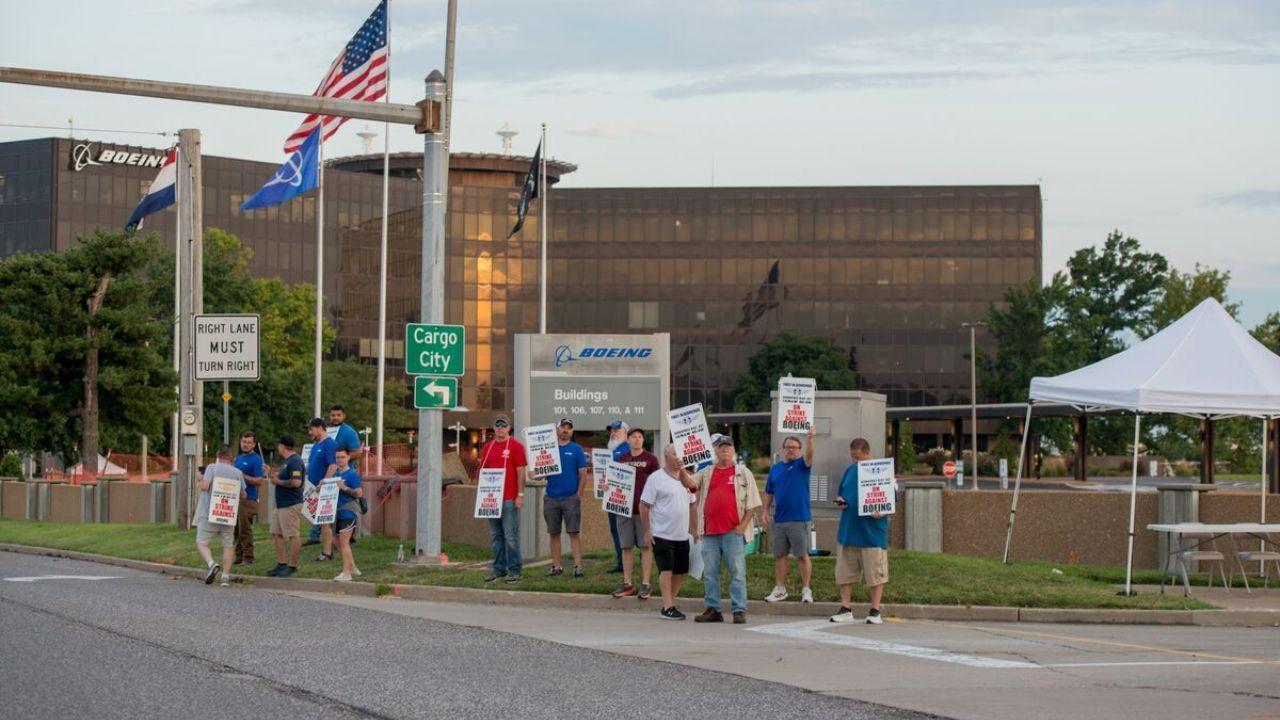
For the workers on strike, the replacement announcement is deeply personal. Picketers outside Boeing’s facilities describe it as a betrayal—proof that the company values production continuity more than the people who have built its aircraft for generations.
Boeing Keeps a Narrow Door Open
While the hiring strategy represents a shift, Boeing has not completely shut down talks. Executives say the company remains open to further discussions, but they maintain that the economic fundamentals of their proposal will not change. Instead, they’ve offered to discuss non-economic issues like shift scheduling and workplace conditions.
Interestingly, Boeing claims only around 10% of union members have sought a personalized pay analysis under the proposed deal. That low figure suggests most workers aren’t even considering the offer seriously, reinforcing the sense of a wide gap between the shop floor and management.
The Role of Labor Law
Boeing’s decision is firmly within legal limits. Under the National Labor Relations Act, companies are permitted to hire permanent replacement workers during economic strikes. However, this does not mean the striking workers are fired—they remain employees but can only return if vacancies exist once replacements are installed.
This creates a tense reality: machinists who have worked at Boeing for decades could find themselves locked out of their jobs indefinitely if Boeing fills the roles. It’s a tactic few companies employ lightly because it risks permanently damaging relationships with both labor and the surrounding community.
A Defense Supply Chain at Risk
At stake in this labor dispute is not just Boeing’s bottom line but the performance of the U.S. defense industrial base. The St. Louis facilities are central to the production of fighter jets that support both the U.S. military and allied nations. Delays in delivery could affect defense readiness and strain international commitments.
Moreover, the ripple effect extends across the supply chain. Boeing relies on hundreds of subcontractors and suppliers who provide everything from composite panels to avionics systems. If St. Louis assembly slows, so too does the flow of orders across this network. While Boeing insists production has continued without major disruption, analysts note that longer strikes inevitably cause bottlenecks in logistics and schedule compliance.
Lessons From Boeing’s Past Struggles
This isn’t Boeing’s first high-stakes labor confrontation. In 2024, a massive machinists’ strike in the Pacific Northwest involving 33,000 workers cost the company billions and damaged its already fragile reputation in commercial aviation. That strike, too, featured accusations of corporate intransigence and long-term damage to workforce relations.
The difference here is scale and context. St. Louis is smaller but strategically critical, tied directly to defense programs rather than commercial aircraft. That changes the calculus: Boeing must weigh the risk of alienating its workforce against the risk of failing to deliver fighter jets and weapons systems under government contracts.
The Quality Question
Hiring replacements in highly technical fields is not like flipping a switch. These roles require certifications, familiarity with Boeing’s unique production systems, and in many cases security clearances that can take months to obtain. Even with aggressive onboarding, it is unlikely that new hires could immediately match the productivity or precision of veteran machinists.
This raises a central question: can Boeing maintain quality standards and delivery schedules while phasing in replacement workers? Critics argue that defense manufacturing is not a field where on-the-job learning can easily replace deep institutional knowledge. Boeing, on the other hand, insists it has robust training protocols and safety checks that will ensure continuity.
Community Impact in St. Louis
Beyond the factory floor, the strike is already reverberating through the St. Louis community. The IAM represents one of the region’s largest pools of skilled industrial workers, and their strike pay is a fraction of their normal income. Local businesses—from diners near the plant to contractors supplying parts—are feeling the strain of reduced economic activity.
Now, with Boeing courting replacement workers, tension is rising. Picket lines have grown louder, community leaders are weighing in, and the specter of long-term division between Boeing and its workforce looms large. For a city with deep roots in aerospace manufacturing, the outcome of this strike could shape its economic landscape for years.
The Path Forward
What happens next hinges on whether Boeing’s hiring strategy is a negotiating tactic or a long-term operational shift. If the company succeeds in onboarding replacements quickly, it could weaken the union’s leverage and force a settlement on Boeing’s terms. However, if replacements struggle to fill the gap, production delays could mount, increasing pressure on Boeing to compromise.
There is also the possibility of political intervention. Given the defense implications, lawmakers and federal mediators may step in to encourage resolution. But for now, both sides appear entrenched: Boeing betting on replacement workers, the IAM betting on solidarity and the irreplaceable value of its skilled labor force.
A Clash of Priorities
The Boeing strike in St. Louis is more than a battle over wages and benefits. It’s a test of how much value a company places on its existing workforce versus its ability to recruit and train new employees under pressure. It’s also a test of how far unions can push back against corporate certainty in an era where supply chains and defense contracts leave little margin for delay.
Boeing’s choice to move forward with replacement workers is a gamble. If successful, it may give the company leverage in future disputes by showing it can weather strikes without crippling its operations. If it fails, it could entrench mistrust, harm production quality, and strain relations not just with workers but with government clients who depend on reliable delivery of critical defense systems.
Either way, this dispute has already cemented itself as a defining labor conflict in modern aerospace—one where the stakes are measured not just in contract clauses, but in national defense, community livelihoods, and the delicate balance of America’s industrial power.
Boeing strike, Replacement workers, Labor dispute



Advances in Aerospace Technology and Commercial Aviation Recovery
Insights into breakthrough aerospace technologies and commercial aviation’s recovery amid 2025 chall

Defense Modernization and Strategic Spending Trends
Explore key trends in global defense modernization and strategic military spending shaping 2025 secu

Tens of Thousands Protest in Serbia on Anniversary of Deadly Roof Collapse
Tens of thousands in Novi Sad mark a year since a deadly station roof collapse that killed 16, prote

Canada PM Carney Apologizes to Trump Over Controversial Reagan Anti-Tariff Ad
Canadian PM Mark Carney apologized to President Trump over an Ontario anti-tariff ad quoting Reagan,

The ad that stirred a hornets nest, and made Canadian PM Carney say sorry to Trump
Canadian PM Mark Carney apologizes to US President Trump after a tariff-related ad causes diplomatic

Bengaluru-Mumbai Superfast Train Approved After 30-Year Wait
Railways approves new superfast train connecting Bengaluru and Mumbai, ending a 30-year demand, easi




