Post by : Sameer Saifi
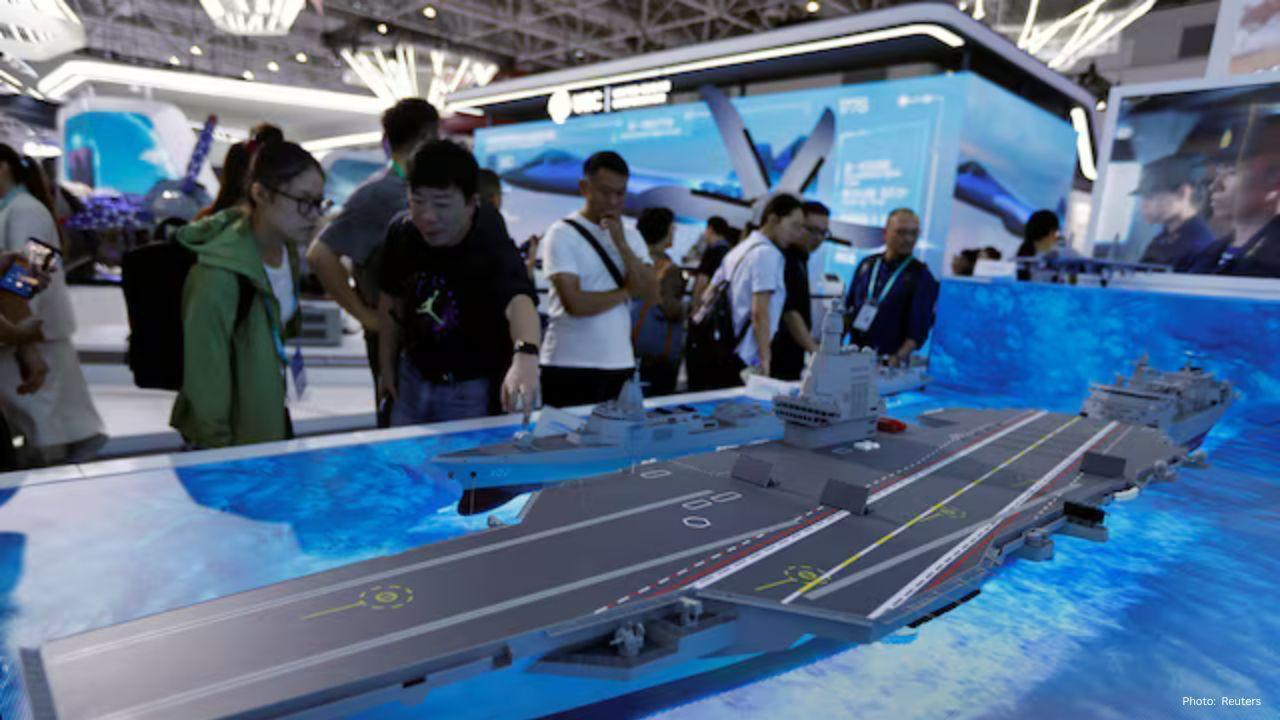
China has officially put its third aircraft carrier, named Fujian, into service this week. The event took place in Hainan province and was attended by President Xi Jinping. The Fujian is the first aircraft carrier that China has fully designed and built by itself. This marks an important moment in China’s growing military power.
The Fujian is different from China’s first two carriers, Liaoning and Shandong. Those earlier carriers were built with help from Russian designs. The Fujian, however, uses more modern technology. It has a flat deck and special electromagnetic catapults to launch aircraft. This system allows planes to take off faster and carry more weapons compared to older launch ramps.
Because of these advances, the Fujian has the potential to carry more fighter jets and heavier aircraft. During its sea trials before entering service, China tested several planes on it. These included the new J-35 stealth fighter, the KJ-600 early warning aircraft, and an upgraded version of the J-15 fighter.
However, even though Fujian has now joined the navy, experts say it will take time before it becomes fully ready for real military missions. Analysts believe it may take at least one more year to train pilots, test equipment, and make sure everything works safely during long missions at sea.
Some military researchers noticed that the J-15 jets were launched without weapons during tests. This suggests that China is still in the early stages of learning how to use the Fujian properly. Running an aircraft carrier is extremely complex. It requires skilled pilots, trained deck crews, and support ships like destroyers and submarines to protect it.
Since China got its first carrier in 2012, the country has moved slowly and carefully. Its carriers have mostly trained close to China’s coastline. In recent years, they have begun to sail further, traveling near Japan and even toward Guam, where the United States has major military bases. With the Fujian now in service, many expect China to become more confident in operating far from its home waters.
Even so, the Fujian is powered by diesel fuel, not nuclear energy. This means it cannot stay at sea as long as American carriers, which use nuclear power and can travel farther without stopping to refuel. So while the Fujian is a big step forward, China still has limits in long-distance naval operations.
The United States has already noted that the Fujian could increase China’s ability to project military power. If used in a naval group with supporting aircraft and warships, it could increase China's influence in areas far from its shores.
Some analysts also believe that China may use Fujian to send strong political messages, especially around Taiwan. However, experts say China still needs more training and planning before the Fujian could be used in any real conflict.
In simple terms, the Fujian is a symbol of China’s growing strength. But it still has a long journey before it becomes fully powerful at sea. The world will now carefully watch how quickly China can train its navy to match this new technology.
#trending #latest #China #FujianCarrier #AsiaSecurity #MilitaryNews #GlobalPolitics



Advances in Aerospace Technology and Commercial Aviation Recovery
Insights into breakthrough aerospace technologies and commercial aviation’s recovery amid 2025 chall

Defense Modernization and Strategic Spending Trends
Explore key trends in global defense modernization and strategic military spending shaping 2025 secu

Tens of Thousands Protest in Serbia on Anniversary of Deadly Roof Collapse
Tens of thousands in Novi Sad mark a year since a deadly station roof collapse that killed 16, prote

Canada PM Carney Apologizes to Trump Over Controversial Reagan Anti-Tariff Ad
Canadian PM Mark Carney apologized to President Trump over an Ontario anti-tariff ad quoting Reagan,

The ad that stirred a hornets nest, and made Canadian PM Carney say sorry to Trump
Canadian PM Mark Carney apologizes to US President Trump after a tariff-related ad causes diplomatic

Bengaluru-Mumbai Superfast Train Approved After 30-Year Wait
Railways approves new superfast train connecting Bengaluru and Mumbai, ending a 30-year demand, easi




