Post by : Saif
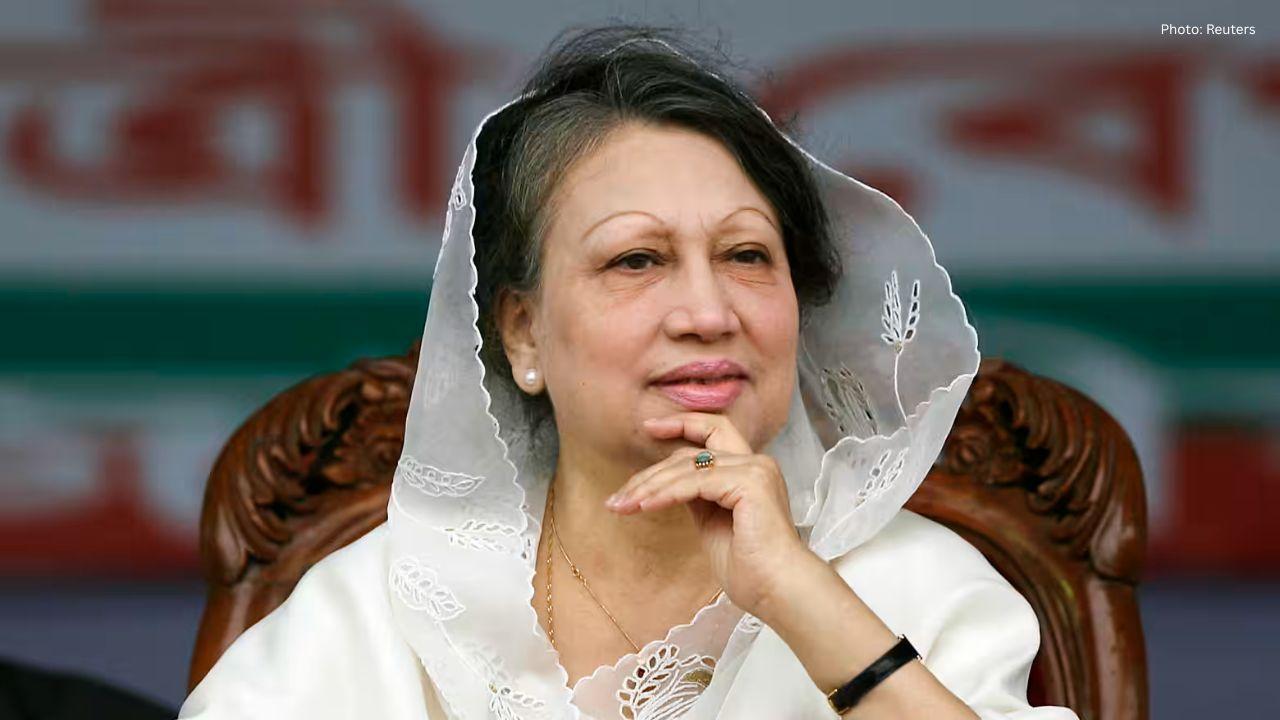
Khaleda Zia, Bangladesh’s first female prime minister and one of the most influential figures in the country’s political history, died on Tuesday at the age of 80 after a long illness. Her party, the Bangladesh Nationalist Party (BNP), confirmed her death. Doctors said she had been suffering from several serious health problems, including liver disease, diabetes, arthritis, and heart and chest complications.
Khaleda Zia had been receiving medical care for years and spent several months in London earlier in 2025 for treatment before returning home. Although she had been out of power for nearly two decades, she remained a powerful symbol for her supporters and continued to shape Bangladesh’s politics through her party and family.
Born into a traditional family, Khaleda Zia was known to be quiet and reserved in her early life. She focused on raising her two sons while her husband, Ziaur Rahman, served as a senior military officer and later as president. Her life changed dramatically in 1981 when Ziaur Rahman was assassinated during an attempted army coup. After his death, Khaleda stepped into politics and took charge of the BNP, the party founded by her husband.
In the late 1980s, Khaleda Zia joined hands with Sheikh Hasina, leader of the Awami League and daughter of Bangladesh’s founding father, to lead a mass movement against military ruler Hossain Mohammad Ershad. Their joint struggle helped restore democracy in 1990. However, their alliance soon turned into a bitter rivalry that would dominate Bangladesh’s politics for decades. The two leaders came to be known as the “battling Begums,” a phrase that reflected both their prominence and their deep political divide.
In 1991, Khaleda Zia led the BNP to victory in what was considered Bangladesh’s first free and fair election. With that win, she became the country’s first female prime minister and one of the first women to lead a democratic government in a Muslim-majority nation. During her first term, she restored the parliamentary system, reduced the powers of the presidency, encouraged foreign investment, and made primary education free and compulsory.
She lost power in 1996 but made a strong comeback in 2001 with a landslide election victory. Her second term, however, was marked by controversy. The country faced rising militant activity, and her government was accused of corruption and weak governance. A deadly grenade attack on a political rally in 2004 further deepened political tensions. Although Khaleda later acted against extremist groups, the damage to her government’s image remained.
Political unrest led to an army-backed interim government taking control in 2006. Both Khaleda Zia and Sheikh Hasina were arrested on corruption charges and spent about a year in detention before being released ahead of the 2008 election. Khaleda never returned to power after that. Her party boycotted later elections, and she spent years either in jail or under house arrest as legal cases continued against her and her family.
In 2018, Khaleda Zia was convicted in a corruption case linked to misuse of charity funds, a charge she strongly denied, saying it was politically motivated. Due to her worsening health, she was moved from prison to house arrest in 2020. She was finally freed in August 2024 following the fall of Sheikh Hasina’s government after a student-led uprising. In early 2025, Bangladesh’s Supreme Court cleared Khaleda and her son, Tarique Rahman, of key corruption charges.
Even in her final years, Khaleda Zia’s influence did not fade. The BNP remains a major political force, and with elections expected in February, her son Tarique Rahman is widely seen as a leading contender for the prime minister’s post. Her death comes at a critical time for Bangladesh, which is currently being governed by an interim administration led by Nobel laureate Muhammad Yunus.
Khaleda Zia’s legacy is complex and deeply tied to Bangladesh’s modern history. Supporters remember her as a dignified and determined leader who fought for democracy and national development. Critics point to the years of political conflict and instability that marked her rivalry with Sheikh Hasina. Regardless of differing views, her role as a trailblazer for women in politics and as a central figure in Bangladesh’s democratic journey is undeniable.
#trending #latest #KhaledaZia #BangladeshPolitics #BangladeshNews #PoliticalLegacy #WomenInPolitics #SouthAsia #armustnews



Advances in Aerospace Technology and Commercial Aviation Recovery
Insights into breakthrough aerospace technologies and commercial aviation’s recovery amid 2025 chall

Defense Modernization and Strategic Spending Trends
Explore key trends in global defense modernization and strategic military spending shaping 2025 secu

Tens of Thousands Protest in Serbia on Anniversary of Deadly Roof Collapse
Tens of thousands in Novi Sad mark a year since a deadly station roof collapse that killed 16, prote

Canada PM Carney Apologizes to Trump Over Controversial Reagan Anti-Tariff Ad
Canadian PM Mark Carney apologized to President Trump over an Ontario anti-tariff ad quoting Reagan,

The ad that stirred a hornets nest, and made Canadian PM Carney say sorry to Trump
Canadian PM Mark Carney apologizes to US President Trump after a tariff-related ad causes diplomatic

Bengaluru-Mumbai Superfast Train Approved After 30-Year Wait
Railways approves new superfast train connecting Bengaluru and Mumbai, ending a 30-year demand, easi




