Post by : Amit
Photo : X / Aviation International News
A New Frontier in Wildfire Response
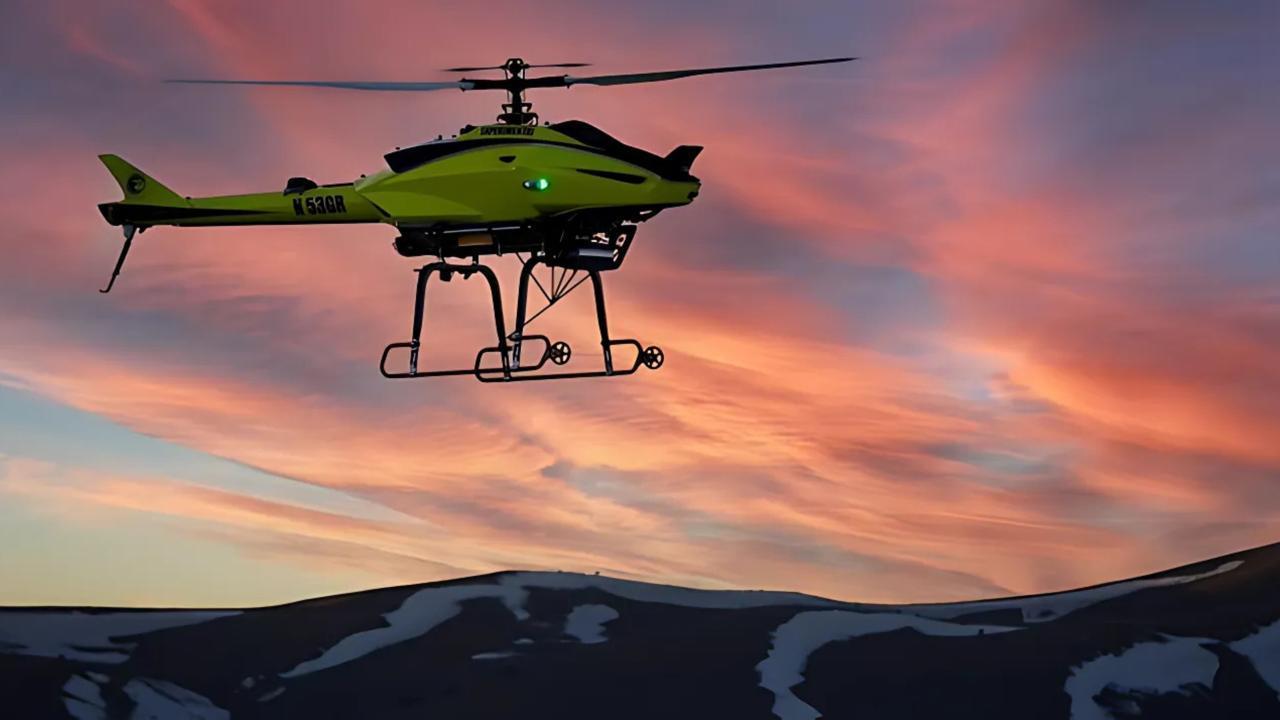
As the wildfire season grows longer and more destructive across the western United States, Oregon has emerged at the forefront of exploring advanced aerial technologies to fight the flames. In a bold initiative, state officials and research partners are studying the use of uncrewed helicopters for wildfire suppression, a move that could redefine firefighting strategies in one of the most fire-prone regions of the country. The project, now under active evaluation, highlights a growing recognition that conventional firefighting methods are no longer sufficient to cope with the increasing scale and intensity of modern wildfires.
The study is significant not only for Oregon but also for the broader wildfire-prone landscape of the U.S., where climate change and human development have created a dangerous mix. Uncrewed aerial systems (UAS), particularly heavy-lift helicopters, could provide the safety, reach, and adaptability needed to supplement and in some cases replace traditional crewed aircraft.
The Rising Challenge of Wildfires
Over the last decade, Oregon has witnessed an alarming escalation in wildfire damage. Data from the Oregon Department of Forestry reveals that the state has experienced several “megafires,” each burning more than 100,000 acres, since 2017. These fires have destroyed homes, disrupted communities, and placed immense pressure on firefighting crews.
Traditional firefighting helicopters, though vital, come with risks and limitations. Pilots often have to operate in dangerous low-visibility conditions, maneuvering over mountainous terrain and through heavy smoke. The strain on crews is compounded by the need for rapid turnaround between missions, often in extreme heat. Fatalities, unfortunately, remain a recurring hazard.
Against this backdrop, the potential of uncrewed helicopters stands out. They promise not only to reduce risks to human life but also to enable round-the-clock operations that are not constrained by crew rest cycles.
The Case for Uncrewed Helicopters
The Oregon study is focusing on uncrewed helicopters capable of transporting significant water payloads or firefighting chemicals to fire zones. Unlike smaller drones currently used for reconnaissance and mapping, these aircraft are designed to replicate or even exceed the lift capacity of conventional crewed helicopters.
According to officials involved, the advantages of uncrewed helicopters are multifold. First, they can fly into high-risk zones without endangering pilots, opening the door for aggressive initial attack strategies when fires are still manageable. Second, they can sustain longer operational hours, including nighttime missions, which are often impossible for crewed aircraft due to visibility and safety regulations. Third, their adaptability allows them to switch roles—from fire suppression to logistics, such as delivering supplies to stranded firefighters or evacuating medical cargo.
This combination of safety, endurance, and versatility makes them an attractive candidate for the next generation of wildfire management.
Testing and Research Partnerships
The Oregon Department of Forestry is collaborating with aerospace partners, research universities, and federal agencies to evaluate the feasibility of integrating uncrewed helicopters into active firefighting campaigns. Initial tests are expected to simulate water drops, remote refueling, and coordinated missions with ground crews.
Industry insiders point to parallels with military applications, where uncrewed rotorcraft have already demonstrated their value in resupply missions in hostile environments. The same principles—automation, resilience, and reduced risk—are now being applied to civilian disaster response.
One senior official involved in the project noted that Oregon’s varied terrain makes it an ideal testbed. From dense forests to rugged mountains, the state provides the conditions necessary to validate how uncrewed helicopters can adapt in real-world wildfire environments.
The Technology Behind the Concept
At the heart of this initiative is propulsion technology capable of sustaining heavy-lift operations. Unlike fixed-wing drones, helicopters provide the vertical lift necessary for water-bucket drops and precision landings in remote fire zones. To achieve this autonomously, advanced avionics, AI-driven navigation systems, and real-time data integration are being built into the prototypes.
Some systems under study are hybrid-electric, combining traditional turbine power with battery-supported systems to improve fuel efficiency and reduce carbon emissions. This sustainability aspect is particularly attractive as governments push for greener solutions even in emergency response sectors.
In addition, developers are working on integrating uncrewed helicopters into existing air traffic systems, ensuring they can operate safely alongside crewed aircraft during complex wildfire operations. That interoperability will be key to their acceptance and eventual deployment.
Overcoming Barriers and Concerns
Despite the promise, significant hurdles remain. Cost is one of the biggest challenges, as developing and operating uncrewed helicopters requires substantial investment in both hardware and supporting infrastructure. Skeptics question whether cash-strapped state firefighting agencies can afford such high-tech solutions.
Another challenge lies in regulatory approval. The Federal Aviation Administration (FAA) has strict guidelines for unmanned aircraft operations, particularly in shared airspace with crewed aircraft. Oregon’s project will require close coordination with the FAA to carve out exemptions or new frameworks that allow safe and legal deployment.
Public perception is another factor. For many, the sight of helicopters—manned by brave pilots—dropping water over burning forests remains a symbol of firefighting heroism. Transitioning to machines could face resistance, especially if communities feel human presence is being diminished in moments of crisis.
National and Global Implications
What Oregon is exploring could have far-reaching consequences. If uncrewed helicopters prove successful in wildfire suppression, they could become a national asset, deployed across California, Washington, Arizona, and other states battling severe wildfires annually.
Globally, too, the technology could find applications. Countries like Australia, Greece, and Canada, which also face devastating wildfire seasons, are watching developments closely. A scalable model from Oregon could be replicated internationally, offering a template for collaborative disaster response strategies.
Experts believe this could even spur a new aerospace subsector focused on uncrewed emergency response vehicles, bridging the gap between defense-driven innovations and civilian needs.
Voices from the Field
Firefighters and community members are cautiously optimistic. One Oregon firefighter described the concept as “a game-changer if it works as promised,” emphasizing the importance of protecting crew lives while increasing firefighting efficiency.
Wildfire experts, however, stress that technology is only part of the solution. They point out that uncrewed helicopters must complement broader wildfire prevention strategies, such as forest management, community planning, and climate adaptation measures. Without addressing root causes, even the most advanced aircraft will be battling an uphill fight.
A Vision for the Future
As Oregon continues its study, the broader vision is clear: a future where technology reduces the risks to human life while enhancing the speed and scale of wildfire suppression. Uncrewed helicopters are not expected to replace human firefighters but to work alongside them, taking on the most dangerous missions and freeing crews to focus on strategic and tactical decision-making.
If successful, Oregon’s initiative could set a precedent for how the U.S.—and potentially the world—confronts the growing wildfire crisis. By marrying aerospace innovation with urgent environmental needs, the project underscores a fundamental truth: fighting tomorrow’s fires will require tools that go beyond yesterday’s limits.
A Race Against Time
The urgency of wildfire threats leaves little room for delay. Each season grows more destructive, with billions of dollars in damages and irreplaceable loss of life and ecosystems. Oregon’s uncrewed helicopter study offers a glimpse of hope, a chance to shift the balance in humanity’s ongoing battle against nature’s fury.
As officials, technologists, and firefighters weigh the possibilities, one fact is certain: the future of wildfire suppression will not be written by tradition alone. It will be shaped by innovation, courage, and the willingness to embrace untested solutions in the face of unprecedented challenges. Oregon’s experiment may be the spark that lights the way forward.
Helicopters for Wildfire Battles



Advances in Aerospace Technology and Commercial Aviation Recovery
Insights into breakthrough aerospace technologies and commercial aviation’s recovery amid 2025 chall

Defense Modernization and Strategic Spending Trends
Explore key trends in global defense modernization and strategic military spending shaping 2025 secu

Tens of Thousands Protest in Serbia on Anniversary of Deadly Roof Collapse
Tens of thousands in Novi Sad mark a year since a deadly station roof collapse that killed 16, prote

Canada PM Carney Apologizes to Trump Over Controversial Reagan Anti-Tariff Ad
Canadian PM Mark Carney apologized to President Trump over an Ontario anti-tariff ad quoting Reagan,

The ad that stirred a hornets nest, and made Canadian PM Carney say sorry to Trump
Canadian PM Mark Carney apologizes to US President Trump after a tariff-related ad causes diplomatic

Bengaluru-Mumbai Superfast Train Approved After 30-Year Wait
Railways approves new superfast train connecting Bengaluru and Mumbai, ending a 30-year demand, easi




