Post by : Saif
Russia has launched its most powerful and concentrated missile attack of the year on Ukraine, sending a strong and troubling message as the war moves deeper into 2026. The overnight assault struck several major cities, killed at least four people, injured many others, and caused serious damage to energy and civilian infrastructure.
According to Ukrainian officials and local media, the attack began early Tuesday morning and lasted about an hour. During this short but intense period, Russian forces fired around 20 ballistic missiles, along with drones, across different parts of the country. While Reuters could not independently confirm the exact number, Ukrainian monitoring channels described it as the heaviest strike so far this year.
The capital city, Kyiv, was one of the main targets. Emergency power cuts were imposed after missiles damaged key infrastructure. Ukraine’s national grid operator, Ukrenergo, said the situation forced authorities to act quickly to prevent wider blackouts. Kyiv’s military administration described the strike as sudden and fierce, catching residents off guard in the early hours of the day.
Energy facilities were again in the crosshairs. DTEK, one of Ukraine’s largest private energy companies, confirmed that equipment at one of its thermal power plants was badly damaged. This continues a clear pattern seen since the start of the invasion in February 2022, with Russia repeatedly targeting power stations, substations, and heating systems, especially during winter months.
In eastern Ukraine, the city of Kharkiv suffered one of the deadliest blows. Regional Governor Oleh Syniehubov said four people were killed when a missile struck the outskirts of the city, which lies just 30 kilometers from the Russian border. Six others were injured. The area has been hit many times before, but this strike caused widespread destruction.
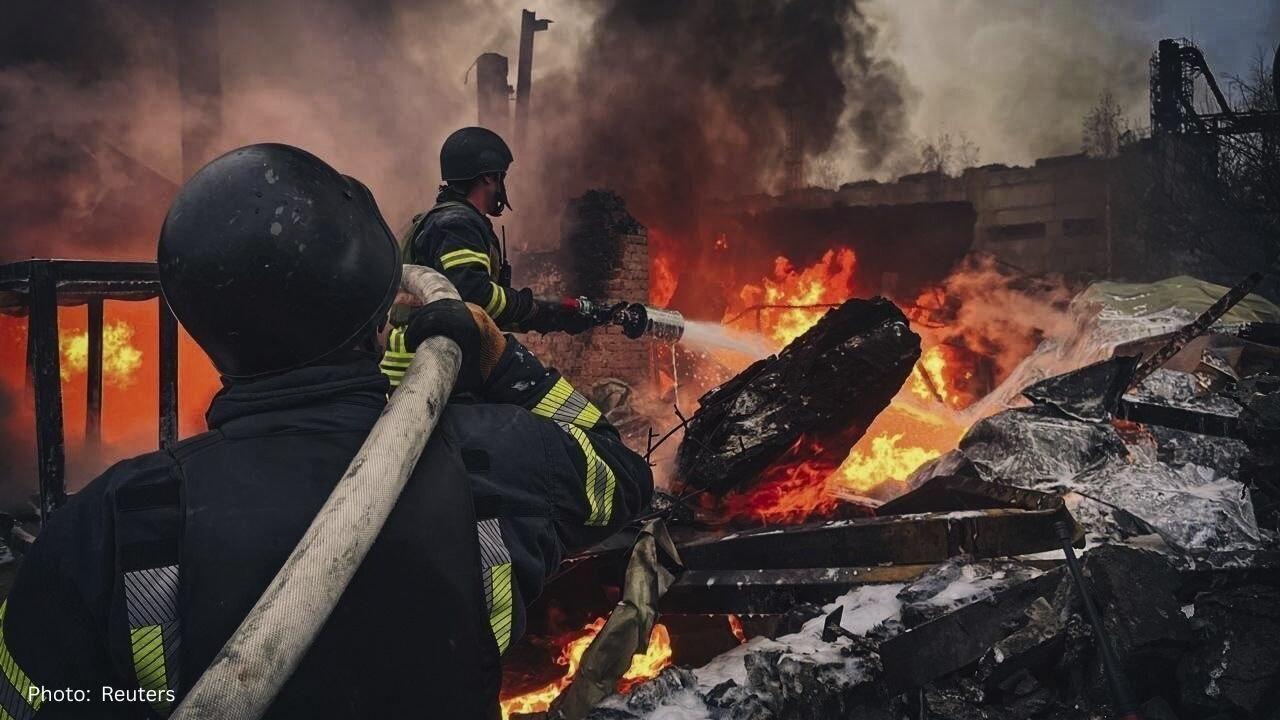
Ukraine’s State Emergency Service reported that the Kharkiv missile hit a postal terminal, destroying buildings and setting off fires across an area of about 500 square meters. Firefighters and rescue teams worked through debris and smoke to save lives. Thirty people were pulled to safety, including two who were trapped under rubble.
Further south, the port city of Odesa also came under attack. Five people were injured as missiles and drones caused fires in several locations, including an unused new building, a fitness center, and a vocational school. Though these buildings were not in use at the time, the damage highlights the constant risk faced by civilians.
In central Ukraine, the industrial city of Kryvyi Rih was also struck. Two people were injured, and officials said the attack damaged civilian buildings, homes, and gas pipelines. Repairs are expected to take time, adding to the strain on local communities already dealing with shortages and uncertainty.
Russia has not commented on the attack, and Ukraine’s armed forces have yet to release a full assessment of the strike. However, the impact is already clear. Lives have been lost, families displaced, and vital services disrupted.
This latest assault comes at a time when Ukraine’s air defense systems are under heavy pressure. While many missiles and drones are intercepted, the sheer scale and speed of these attacks make full protection difficult. Each new wave tests Ukraine’s defenses and drains resources.
Beyond the immediate damage, the attack deepens the humanitarian crisis. Power cuts in winter affect heating, hospitals, schools, and basic daily life. For ordinary Ukrainians, these strikes are not just military events; they are personal tragedies that touch every part of society.
From an editorial standpoint, this attack shows how the war remains far from over. Despite talks in global forums and repeated calls for peace, the violence continues to rise. The use of such a concentrated missile barrage suggests an effort to weaken Ukraine’s resilience and morale by targeting critical infrastructure and cities.
The international community faces renewed pressure to respond. Each major strike raises questions about air defense support, humanitarian aid, and diplomatic efforts. For Ukraine, survival depends not only on military strength but also on keeping lights on, homes warm, and people safe.
As 2026 unfolds, this attack stands as a grim reminder of the war’s intensity. It shows that civilians remain at the heart of the conflict, bearing the heaviest cost. Until the fighting stops, nights like this will continue to shape daily life in Ukraine, filled with sirens, fear, and uncertainty.
#trending #latest #UkraineWar #RussiaUkraine #MissileAttack #Kyiv #Kharkiv #Odesa #BreakingNews #WorldNews #HumanitarianCrisis



Advances in Aerospace Technology and Commercial Aviation Recovery
Insights into breakthrough aerospace technologies and commercial aviation’s recovery amid 2025 chall

Defense Modernization and Strategic Spending Trends
Explore key trends in global defense modernization and strategic military spending shaping 2025 secu

Tens of Thousands Protest in Serbia on Anniversary of Deadly Roof Collapse
Tens of thousands in Novi Sad mark a year since a deadly station roof collapse that killed 16, prote

Canada PM Carney Apologizes to Trump Over Controversial Reagan Anti-Tariff Ad
Canadian PM Mark Carney apologized to President Trump over an Ontario anti-tariff ad quoting Reagan,

The ad that stirred a hornets nest, and made Canadian PM Carney say sorry to Trump
Canadian PM Mark Carney apologizes to US President Trump after a tariff-related ad causes diplomatic

Bengaluru-Mumbai Superfast Train Approved After 30-Year Wait
Railways approves new superfast train connecting Bengaluru and Mumbai, ending a 30-year demand, easi




