Post by : Saif
Taiwan has accused China of using large-scale military exercises to weaken growing international support for the island and to distract attention from economic and social problems inside China. The claims were made in a new report by Taiwan’s National Security Bureau, which was presented to lawmakers and reviewed by Reuters.
According to the report, China’s military drills, known as “Justice Mission 2025,” were not only about military readiness. Taiwan says the exercises had strong political goals and were designed to send a message to the world at a time when more democratic countries are speaking openly in support of Taiwan.
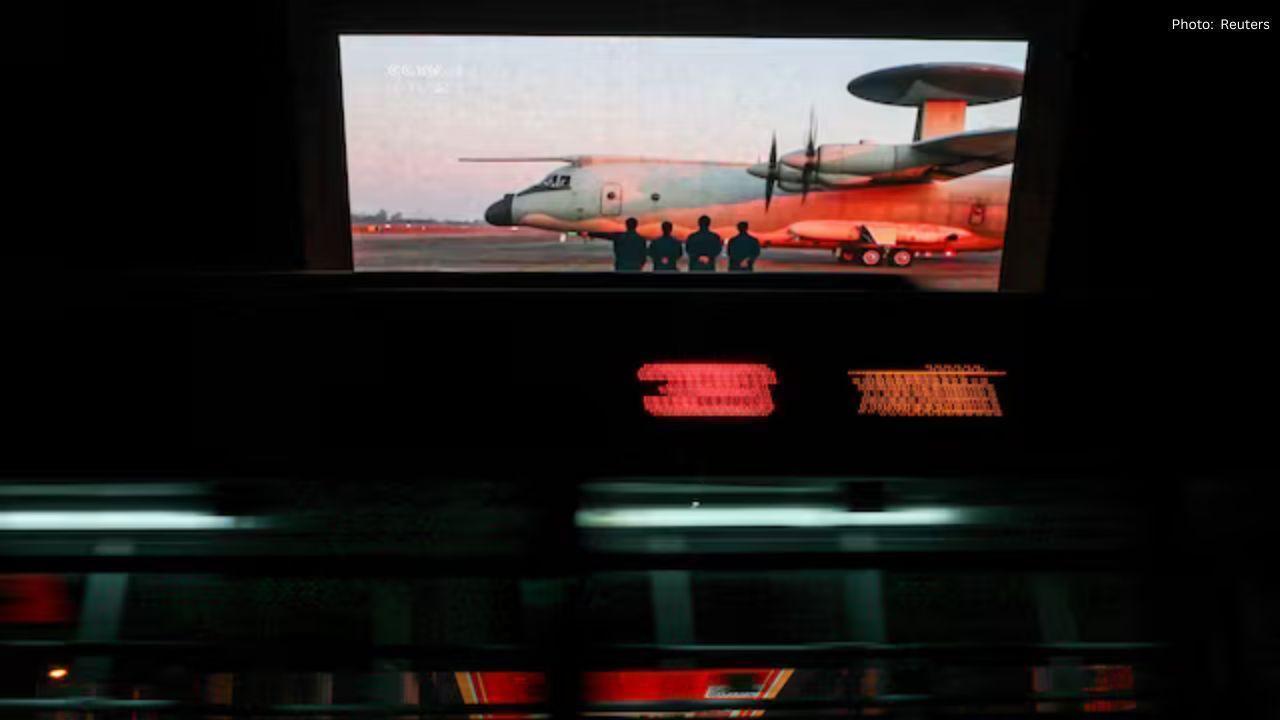
During the drills, China fired dozens of rockets in areas near Taiwan and sent large numbers of warships and military aircraft close to the island. The scale of the exercises forced Taiwan to cancel dozens of domestic flights and raised alarm among neighboring countries, as well as the United States and European allies. Taiwan described the drills as the largest by China so far in terms of the area covered.
The security report said the exercises were meant to counter growing backing for Taiwan from democratic partners. It also said China was trying to turn public anger at home away from economic slowdowns and social stress by stirring strong nationalist feelings. By focusing on tensions with Taiwan, Beijing could rally domestic support under the idea of resisting foreign interference, the report said.
Taiwan also warned that the drills were part of a wider “hybrid” campaign. This campaign combines military pressure, economic threats, information warfare, and cyberattacks. The report said China is increasing pressure on Taiwan from many directions at once, while Taiwan continues to receive political and security support from the United States, Japan, and European countries.
The report highlighted a comment made last year by Japanese Prime Minister Sanae Takaichi, who said a Chinese attack on Taiwan could pose an existential threat to Japan. Taiwan said this shows that stability in the Taiwan Strait is no longer a local issue, but a key part of regional and global security in the Indo-Pacific.
China rejected Taiwan’s claims. At a regular press briefing, China’s Taiwan Affairs Office said the military drills were carried out to defend national sovereignty and territorial integrity. It said the exercises were meant to protect what Beijing calls the shared interests of people on both sides of the Taiwan Strait. China continues to claim Taiwan as its own territory and has not ruled out using force to bring the island under its control.
Taiwan strongly disagrees with China’s position. The government in Taipei says Taiwan is already a self-governing democracy and that only the people of Taiwan have the right to decide their future.
The security report also said China used information warfare during the drills. According to Taiwan, Chinese state media, artificial intelligence-generated content, and coordinated online accounts were used to spread messages meant to weaken trust in Taiwan’s military and government. These efforts also aimed to damage confidence in President Lai Ching-te and Taiwan’s relationship with the United States.
The report said nearly 19,000 controversial messages were posted by hundreds of online accounts across social media platforms in just five days. At the same time, Taiwan faced a sharp rise in cyberattacks. On the first two days of the drills alone, more than two million cyberattacks targeted government systems. Taiwan linked some of the activity to hacking groups connected to China’s military, including APT24 and BlackTech.
Taiwan said China has increasingly synchronized cyberattacks with military drills to disrupt daily life, damage cybersecurity systems, and unsettle public morale. China has repeatedly denied involvement in hacking activities.
From an editorial standpoint, Taiwan’s report highlights how modern conflicts are no longer fought only with weapons. Information control, cyber operations, and political messaging have become powerful tools alongside military force. The situation in the Taiwan Strait remains one of the most sensitive flashpoints in the world, with risks that go far beyond the region.
As tensions continue, clear communication, restraint, and international cooperation will be critical. Any misstep could affect not just Taiwan and China, but global trade, regional stability, and the broader international order.
#trending #latest #Taiwan #China #TaiwanStrait #IndoPacific #GlobalSecurity #CyberWarfare #MilitaryDrills #Geopolitics #AsiaNews #armustnews



Advances in Aerospace Technology and Commercial Aviation Recovery
Insights into breakthrough aerospace technologies and commercial aviation’s recovery amid 2025 chall

Defense Modernization and Strategic Spending Trends
Explore key trends in global defense modernization and strategic military spending shaping 2025 secu

Tens of Thousands Protest in Serbia on Anniversary of Deadly Roof Collapse
Tens of thousands in Novi Sad mark a year since a deadly station roof collapse that killed 16, prote

Canada PM Carney Apologizes to Trump Over Controversial Reagan Anti-Tariff Ad
Canadian PM Mark Carney apologized to President Trump over an Ontario anti-tariff ad quoting Reagan,

The ad that stirred a hornets nest, and made Canadian PM Carney say sorry to Trump
Canadian PM Mark Carney apologizes to US President Trump after a tariff-related ad causes diplomatic

Bengaluru-Mumbai Superfast Train Approved After 30-Year Wait
Railways approves new superfast train connecting Bengaluru and Mumbai, ending a 30-year demand, easi




