Post by : Saif
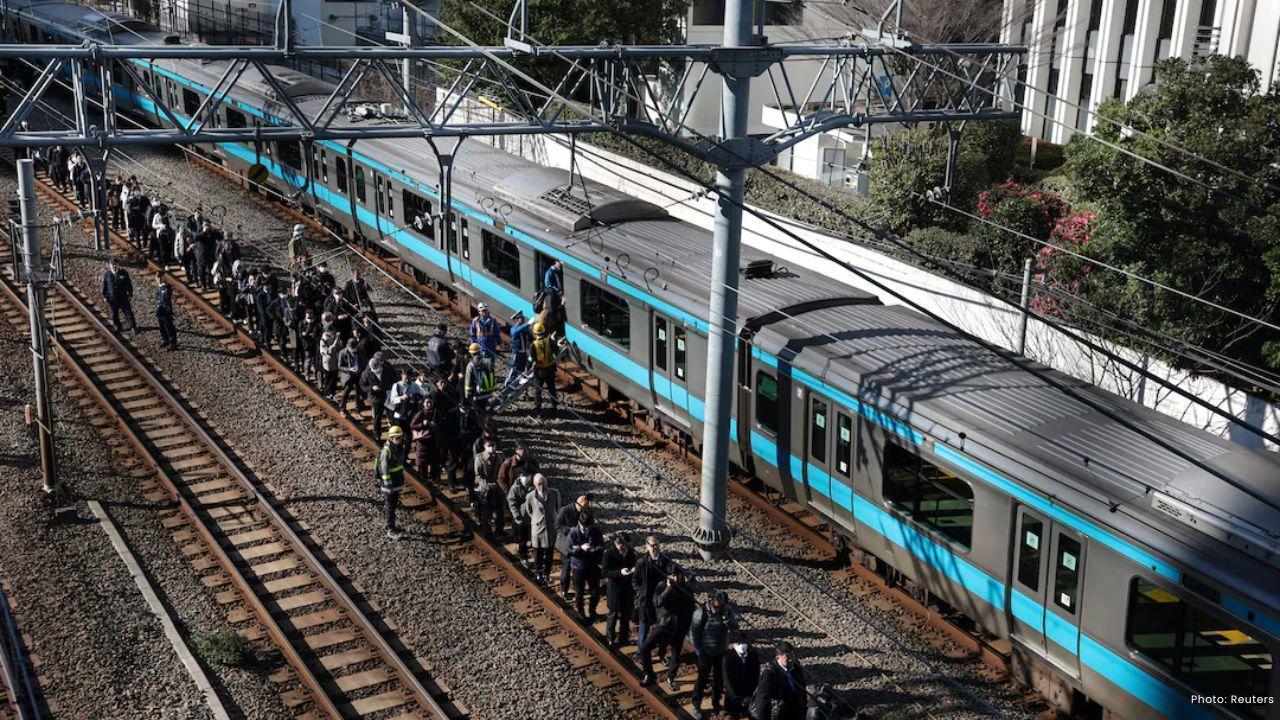
Tokyo, one of the world’s busiest cities, faced major disruption on Friday morning after a power outage forced the shutdown of two of its most important commuter train lines. The incident affected around 673,000 passengers and brought daily travel to a halt across large parts of the city.
The outage struck the Yamanote Line and the Keihin-Tohoku Line, both operated by East Japan Railway Company, widely known as JR East. These two lines serve some of Tokyo’s busiest stations, including Shinjuku, Tokyo Station, and Yokohama. Many commuters rely on them every day to reach work, school, and other essential places.
According to the railway operator, the problem began after overnight maintenance work at Tamachi Station. Power could not be restored as planned, leaving the tracks without electricity early in the morning. Smoke was later seen coming from equipment near the tracks, which added to safety concerns and delayed repairs.
As trains stopped between stations, emergency teams stepped in. Passengers were carefully evacuated from stranded trains and guided along the tracks to nearby stations. Firefighters and railway staff helped ensure that everyone reached safety. Images shared online showed crowded platforms and long lines of confused commuters waiting for updates.
Some train services were stopped for as long as nine hours, turning the morning rush into a day-long challenge. Shinjuku Station alone normally handles millions of passengers each day, and even a short delay can cause widespread problems. With both major lines down, alternative routes quickly became overcrowded.
Thankfully, no injuries were reported. Still, the incident raised questions about the strength of railway systems in a city known for its punctual and reliable public transport. For many commuters, the disruption was not just an inconvenience but a reminder of how much daily life depends on smooth transport operations.
JR East has said it will investigate the cause of the outage and review safety procedures to prevent similar incidents in the future. Passengers, meanwhile, are hoping for quick improvements and clearer communication during emergencies.
This event shows how even a small technical failure can affect hundreds of thousands of lives in a major city. As Tokyo continues to grow and depend on its rail network, ensuring strong safety checks and fast response systems will remain a top priority.
#trending #latest #Tokyo #JapanRailways #PowerOutage #PublicTransport #CommuterLife #UrbanInfrastructure



Advances in Aerospace Technology and Commercial Aviation Recovery
Insights into breakthrough aerospace technologies and commercial aviation’s recovery amid 2025 chall

Defense Modernization and Strategic Spending Trends
Explore key trends in global defense modernization and strategic military spending shaping 2025 secu

Tens of Thousands Protest in Serbia on Anniversary of Deadly Roof Collapse
Tens of thousands in Novi Sad mark a year since a deadly station roof collapse that killed 16, prote

Canada PM Carney Apologizes to Trump Over Controversial Reagan Anti-Tariff Ad
Canadian PM Mark Carney apologized to President Trump over an Ontario anti-tariff ad quoting Reagan,

The ad that stirred a hornets nest, and made Canadian PM Carney say sorry to Trump
Canadian PM Mark Carney apologizes to US President Trump after a tariff-related ad causes diplomatic

Bengaluru-Mumbai Superfast Train Approved After 30-Year Wait
Railways approves new superfast train connecting Bengaluru and Mumbai, ending a 30-year demand, easi




