Post by : Amit
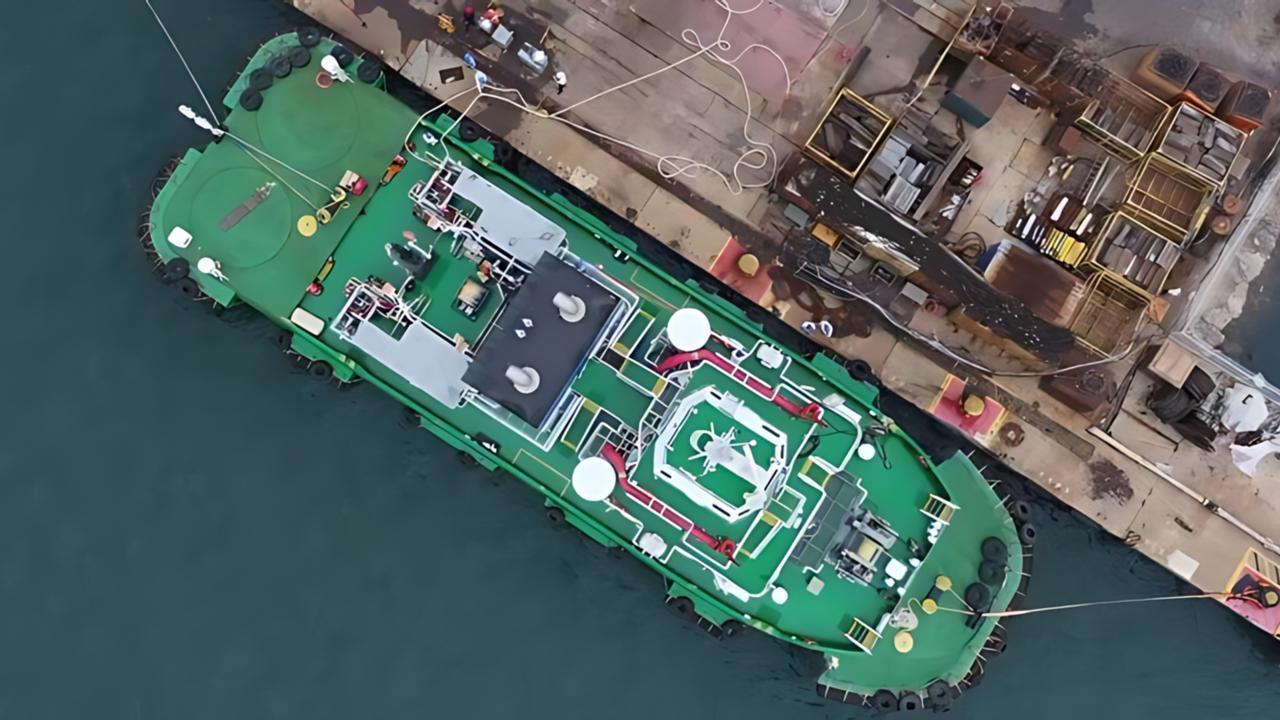
Photo : X / Fuel Cells Works
Shanghai, July, 2025 — A groundbreaking milestone in the global effort to decarbonize maritime shipping has just been achieved in China. Envision Energy, a global green tech and energy leader, has officially launched the world’s first green marine ammonia bunkering operation at the Port of Zhoushan, marking the beginning of a new era for net-zero propulsion in maritime logistics.
This pioneering achievement positions Envision Energy at the heart of the global transition away from fossil fuel-based shipping, and toward low-carbon, scalable alternatives. The project, developed in collaboration with several port authorities and industrial partners, demonstrates how green ammonia—a fuel derived from renewable electricity and nitrogen—can be safely and efficiently used to power commercial ships.
The pilot operation in Zhoushan is more than a demonstration—it is a proof-of-concept that could dramatically reshape the future of global maritime energy. The move also underscores China’s growing leadership in clean shipping innovations and port decarbonization strategies.
Ammonia: The Fuel of the Future for Clean Shipping?
The marine shipping sector is responsible for approximately 3% of global greenhouse gas (GHG) emissions, with the majority of vessels still operating on high-sulfur bunker fuel. As the world races toward decarbonization, ammonia has emerged as one of the most promising next-generation fuels for large cargo vessels and tankers. Unlike hydrogen, ammonia is easier to store and transport, has a higher energy density, and produces no carbon dioxide when combusted or used in fuel cells.
Envision Energy’s innovation lies in its ability to produce green ammonia—ammonia synthesized using green hydrogen (from water electrolysis powered by renewable energy) and nitrogen captured from the air. This makes it a carbon-neutral fuel throughout its lifecycle.
During the bunkering demonstration in Zhoushan, green ammonia was successfully transferred from onshore storage tanks to a purpose-built receiving vessel equipped with ammonia-compatible engines. The operation was carried out under strict safety protocols, involving multiple redundancies, air monitoring, and fire-suppression systems—establishing a benchmark for how ammonia can be handled at scale in real-world ports.
Envision Energy’s Role: Tech Convergence in Action
Envision Energy’s leadership in this landmark project is no surprise. Over the last decade, the company has evolved from a wind turbine manufacturer into a full-spectrum green tech provider—covering wind, solar, battery storage, green hydrogen, and digital AI-powered energy management systems.
The green ammonia bunkering project combines all of Envision’s capabilities into one cohesive solution. The ammonia used was generated using green hydrogen produced from Envision’s electrolyzers powered by its own wind turbines. The entire process—from ammonia synthesis to port delivery and ship bunkering—was digitally monitored using Envision’s proprietary AIoT energy management platform.
“Today marks a defining moment in sustainable maritime energy,” said Lei Zhang, CEO of Envision Energy. “We are not just talking about the future. We are building it—by integrating clean generation, clean molecules, and digital intelligence into one net-zero shipping solution.”
Why Zhoushan? A Strategic Marine Energy Hub
Zhoushan, located in eastern China’s Zhejiang Province, is one of the world’s largest bunkering ports by volume. Its deep-water facilities, advanced port infrastructure, and proximity to major shipping lanes make it a prime location for testing future fuels. With over 60 million tons of oil bunkered annually, any green transition at Zhoushan will have ripple effects across the global shipping industry.
The city has been a pilot site for several green port initiatives, including LNG bunkering, electrified berth systems, and AI-enabled cargo scheduling. By enabling green ammonia as a bunkering option, Zhoushan sends a powerful signal: the age of oil-dominated shipping is coming to an end.
The demonstration involved coordination between Envision Energy, local maritime authorities, emergency services, and classification societies to ensure compliance with International Maritime Organization (IMO) regulations on alternative fuel safety and port bunkering.
Scaling Up: From Demonstration to Deployment
While the Zhoushan project was a pilot, Envision Energy has indicated plans to scale operations rapidly. The company aims to develop a full-fledged green ammonia supply chain—spanning production, storage, port infrastructure, and ship engine compatibility.
According to internal projections, Envision expects to produce over 1 million tons of green ammonia annually by 2030 through partnerships in China, the Middle East, and Latin America. These ammonia hubs will be strategically linked to shipping corridors like the Asia-Europe route, the Trans-Pacific lanes, and the Indian Ocean network.
The company is also working with shipbuilders and engine manufacturers to retrofit existing vessels and design new ones that run on ammonia-compatible dual-fuel or solid oxide fuel cell systems.
“This is just the beginning,” said Chief Sustainability Officer Dr. Lili Xu. “We envision a future where every port has green ammonia bunkering capability, and every shipping company has zero-emission vessels in their fleet.”
Regulatory Alignment and Global Momentum
The timing of Envision’s breakthrough is aligned with broader regulatory changes. The International Maritime Organization has set ambitious targets to reduce GHG emissions from international shipping by 40% by 2030 and to reach net-zero emissions “by or around 2050.” These goals are impossible to meet without clean fuels—and ammonia is high on the IMO’s list.
Earlier this year, the IMO approved new safety codes for ammonia handling and bunkering, making this demonstration not only timely but necessary. Moreover, the European Union’s FuelEU Maritime initiative and the U.S. Clean Shipping Act are both pushing toward aggressive emissions cuts in maritime transport.
Envision’s success in Zhoushan may well inspire similar pilots in Rotterdam, Singapore, and Los Angeles—all ports that are actively exploring green fuel bunkering infrastructure.
Market Impact and Industry Reactions
The shipping industry is already taking notice. Envision Energy’s milestone has stirred conversations among energy majors, shipowners, and port authorities. Multiple Memoranda of Understanding (MoUs) have reportedly been signed in recent weeks with global shipping firms interested in co-developing green ammonia routes.
According to S&P Global, the global demand for low-carbon ammonia could reach 300 million tons per year by 2050, driven by fertilization, shipping, and energy storage. If Envision can lead the way in shipping, it could become one of the world’s top ammonia suppliers.
Lloyd’s Register, a leading maritime classification society, praised the pilot. “This is a major step toward commercializing zero-emission maritime fuel. It answers the ‘how’ question that has long dogged ammonia,” said Emma Lee, Asia-Pacific Technical Director at Lloyd’s.
Safety Still the Big Question
Despite the promise, concerns remain—primarily about ammonia’s toxicity and potential for accidental leaks. Ammonia, while carbon-free, is hazardous to human health and the environment if not handled correctly.
To address this, Envision deployed AI-driven ammonia detection sensors, real-time leak monitoring systems, and automated shutdown protocols throughout the demonstration. In addition, all bunkering crews underwent specialized ammonia safety training, with drills conducted under supervision.
Marine environmentalists warn that the scale-up must be accompanied by rigorous international standards. “Green ammonia can’t just be a buzzword. Its deployment must be as safe as it is sustainable,” said Michelle Tan, Marine Lead at Clean Sea Initiative, a Shanghai-based NGO.
Net-Zero Shipping Is No Longer a Dream
The success of Envision Energy’s green ammonia bunkering demonstration proves that zero-emission maritime fuel is no longer theoretical. It is real, scalable, and deployable—right now.
As climate deadlines loom and pressure mounts on hard-to-abate sectors, shipping has reached a critical juncture. Green ammonia offers the most promising pathway for decarbonizing long-haul maritime trade without sacrificing performance, energy density, or scalability.
From the wind farms powering electrolysis to the smart bunkering systems managing transfer operations, Envision Energy has created a model that could be replicated across continents. The project may be based in Zhoushan, but its implications stretch from the docks of Europe to the ports of Africa and beyond.
And in doing so, it proves that sustainable shipping isn’t just about cutting emissions—it’s about reimagining the entire logistics chain with clean energy at its core.
World’s First Green Marine



Advances in Aerospace Technology and Commercial Aviation Recovery
Insights into breakthrough aerospace technologies and commercial aviation’s recovery amid 2025 chall

Defense Modernization and Strategic Spending Trends
Explore key trends in global defense modernization and strategic military spending shaping 2025 secu

Tens of Thousands Protest in Serbia on Anniversary of Deadly Roof Collapse
Tens of thousands in Novi Sad mark a year since a deadly station roof collapse that killed 16, prote

Canada PM Carney Apologizes to Trump Over Controversial Reagan Anti-Tariff Ad
Canadian PM Mark Carney apologized to President Trump over an Ontario anti-tariff ad quoting Reagan,

The ad that stirred a hornets nest, and made Canadian PM Carney say sorry to Trump
Canadian PM Mark Carney apologizes to US President Trump after a tariff-related ad causes diplomatic

Bengaluru-Mumbai Superfast Train Approved After 30-Year Wait
Railways approves new superfast train connecting Bengaluru and Mumbai, ending a 30-year demand, easi




