Post by : Saif
Audi has defended its planned $4 billion investment in a new factory in Georgia, United States, after its chief executive appeared alongside President Donald Trump at a political rally. The project is expected to expand the German automaker’s production in the American market, reduce its reliance on imported vehicles and create thousands of jobs.
Audi CEO Gernot Döllner said the investment plan followed months of planning and negotiations. However, the project still requires final approval from Volkswagen’s supervisory board before construction can proceed.
The proposed factory in central Georgia is expected to produce around 200,000 sport utility vehicles (SUVs) annually. According to information shared by US officials, the facility could assemble the Audi Q7, Q8 and Q9 models.
Audi has estimated that the investment will create approximately 4,500 jobs. Construction is scheduled to begin in 2027, while vehicle production is expected to start in the early 2030s.
The factory would mark a significant expansion of Audi’s manufacturing operations in the United States. The company currently imports all the vehicles it sells in the American market from Europe or Mexico.
Expanding local production could help Audi serve US customers more directly and reduce its exposure to import duties on vehicles and automotive components.
Trump announced the proposed investment while appearing at a rally in Perry, Georgia, on October 24. The US president has repeatedly argued that tariffs on imported goods encourage companies to manufacture products inside the country.
The announcement comes as Republicans prepare for the November 2026 midterm elections. Georgia is an important political battleground, with competitive races for the US Senate and governor.
The administration is presenting domestic manufacturing investments as evidence that its trade policies can attract industrial activity and support American employment.
However, critics argue that tariffs can increase production costs, push up vehicle prices and make businesses less willing to invest when future trade conditions remain uncertain.
Audi has said that US tariffs on automobiles, steel, aluminium and parts cost the company approximately €1.2 billion, or $1.4 billion, last year.
Audi’s plans have sparked debate in Germany, where the automotive industry is already facing economic pressure, job cuts and possible factory closures.
A representative of IG Metall, Germany’s major industrial union, criticised the decision by Döllner to appear alongside Trump during the election campaign. The union argued that US tariff policies have put additional pressure on German manufacturers and their domestic operations.
At the same time, IG Metall leader Christiane Benner acknowledged that improving Volkswagen’s position in the American market was important. She stressed that the company must also provide clear assurances about employment at its German facilities.
The debate reflects a wider concern among European automakers and workers: expanding production in the United States should not come at the expense of manufacturing jobs in Germany.
Olaf Lies, the premier of Lower Saxony, has also called for the investment to benefit German workers. The German state is Volkswagen’s second-largest shareholder, giving it a significant interest in the company’s long-term strategy.
Lies said growth in the United States should help protect employment and economic value in Germany rather than replace domestic production.
Volkswagen has been under pressure to improve its financial performance while dealing with high costs, competition and labour disputes. Expanding manufacturing in the United States could strengthen its market position, but the company must balance that strategy with its commitments to workers at home.
Döllner declined to disclose the full details of the proposed investment agreement, including whether Audi would receive any tariff relief from the US government.
Alongside the Georgia project, Audi is planning to produce approximately 25,000 vehicles annually in neighbouring South Carolina, according to a US official familiar with the plans.
Some vehicles currently manufactured in Europe would be exported from the United States, potentially giving the company a broader production and distribution network.
These plans indicate that Audi is considering a larger role for US manufacturing as it responds to trade barriers and changing market conditions.
However, the final scale and timing of the Georgia project will depend on Volkswagen’s approval and the details of the investment arrangement.
Read more: Tesla September Registrations Rise Across Europe, Extending Recovery
The proposed factory highlights how tariffs are influencing investment decisions across the global automotive industry. For Audi, local production could reduce import-related costs and strengthen its position in one of the world's largest vehicle markets.
For the United States, the project could bring thousands of jobs and expand domestic SUV manufacturing. For Germany, however, the investment raises questions about whether overseas growth will protect or weaken employment at home.
#trending #latest #Audi #AudiGeorgia #DonaldTrump #USManufacturing #AutomotiveIndustry #Volkswagen #TradeTariffs #Germany #USEconomy #CarIndustry #AudiSUV #GeorgiaNews #GlobalBusiness #ManufacturingJobs



Advances in Aerospace Technology and Commercial Aviation Recovery
Insights into breakthrough aerospace technologies and commercial aviation’s recovery amid 2025 chall
Defense Modernization and Strategic Spending Trends
Explore key trends in global defense modernization and strategic military spending shaping 2025 secu

Tens of Thousands Protest in Serbia on Anniversary of Deadly Roof Collapse
Tens of thousands in Novi Sad mark a year since a deadly station roof collapse that killed 16, prote
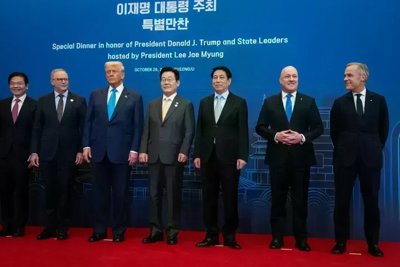
Canada PM Carney Apologizes to Trump Over Controversial Reagan Anti-Tariff Ad
Canadian PM Mark Carney apologized to President Trump over an Ontario anti-tariff ad quoting Reagan,

The ad that stirred a hornets nest, and made Canadian PM Carney say sorry to Trump
Canadian PM Mark Carney apologizes to US President Trump after a tariff-related ad causes diplomatic

Bengaluru-Mumbai Superfast Train Approved After 30-Year Wait
Railways approves new superfast train connecting Bengaluru and Mumbai, ending a 30-year demand, easi