Post by : Saif
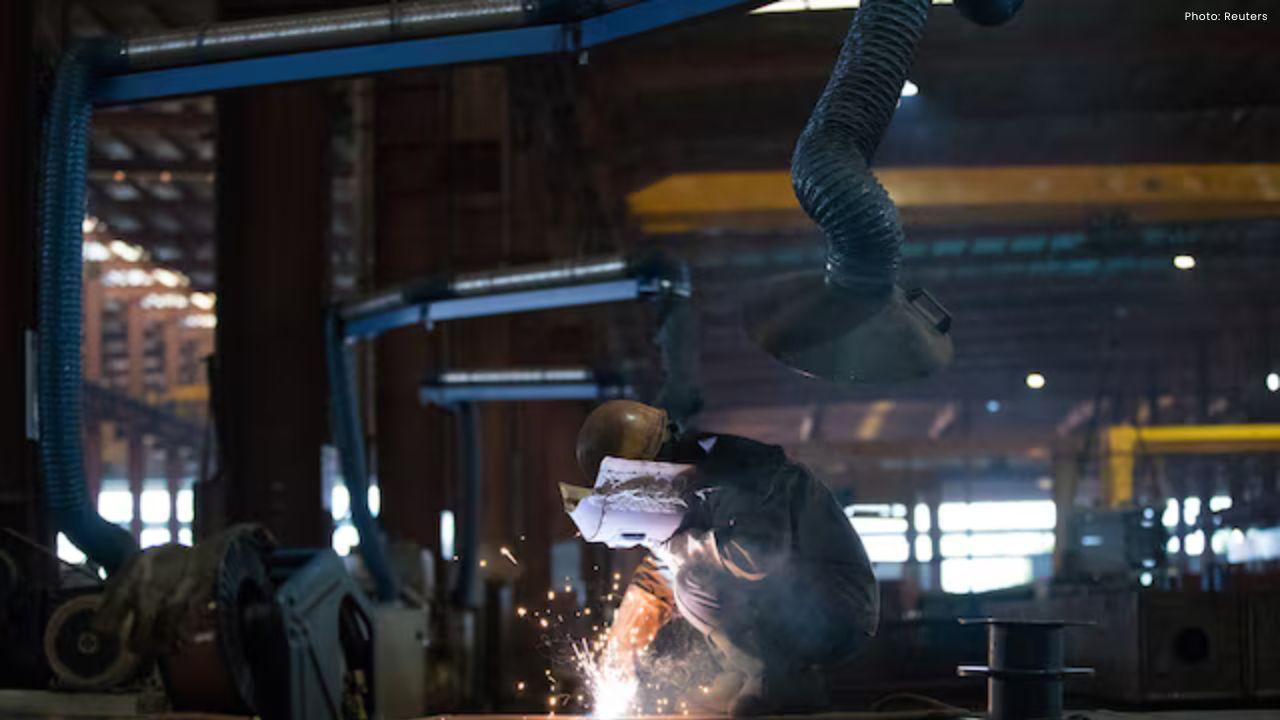
China’s factory sector showed signs of fresh weakness at the start of 2026, raising concerns about the strength of the country’s economic recovery. Official data released on January 31 showed that manufacturing activity slipped into contraction territory, mainly due to weak demand at home and abroad.
According to China’s National Bureau of Statistics, the official manufacturing purchasing managers’ index, or PMI, fell to 49.3 in January. This was down from 50.1 in December. A reading below 50 means factory activity is shrinking rather than growing. Economists had expected the index to stay around 50, so the drop came as a disappointment.
The slowdown was not limited to factories alone. The non-manufacturing PMI, which measures activity in services and construction, also fell. It dropped to 49.4 in January from 50.2 in December. This was its lowest level since late 2022, showing that weakness is spreading across more parts of the economy.
Key parts of the factory survey showed worrying trends. New orders fell to 49.2 from 50.8, while new export orders dropped further to 47.8. This means fewer customers, both inside China and overseas, are placing new orders. Lower demand often leads factories to cut production, delay investment, and reduce hiring.
A government statistician said January is often a slower month for some manufacturers, but admitted that market demand remains weak. This suggests the problem is not only seasonal but also linked to deeper economic challenges.
China met its official growth target of 5% last year, helped largely by strong exports. However, that headline number hid several problems. Retail sales weakened toward the end of 2025, and economic growth in the final quarter slowed to its lowest level in three years. Many families remain cautious about spending, which continues to hurt domestic demand.
Policymakers are becoming more uneasy as this slowdown continues. To support consumers, the government has already used part of its special treasury bond funds to offer subsidies for replacing items like home appliances and smartphones. The central bank has also cut some sector-specific interest rates and signaled it may lower banks’ reserve requirements later this year.
Despite these steps, experts are unsure how effective they will be. Many believe China needs stronger and broader measures to boost spending and confidence. Some economists warn that without more action, it will be hard for China to keep growth above 4.5% in 2026.
At the same time, the government is shifting focus toward services consumption to absorb excess factory output. Leaders are also pushing for advanced manufacturing and greater technology self-reliance to reduce dependence on foreign markets and protect against trade restrictions.
President Xi Jinping has stressed that domestic demand must become the main driver of economic growth. Officials are expected to set this year’s growth target between 4.5% and 5%, showing a cautious approach as they balance stimulus with financial risks.
Overall, January’s PMI figures send a clear message. China’s economy is under pressure, and while policymakers are acting, many challenges remain. The coming months will be crucial in deciding whether these efforts are enough to stabilize growth and restore confidence.
#trending #latest #ChinaEconomy #ManufacturingPMI #GlobalEconomy #EconomicGrowth #FactoryOutput #AsiaMarkets







Advances in Aerospace Technology and Commercial Aviation Recovery
Insights into breakthrough aerospace technologies and commercial aviation’s recovery amid 2025 chall

Defense Modernization and Strategic Spending Trends
Explore key trends in global defense modernization and strategic military spending shaping 2025 secu

Tens of Thousands Protest in Serbia on Anniversary of Deadly Roof Collapse
Tens of thousands in Novi Sad mark a year since a deadly station roof collapse that killed 16, prote

Canada PM Carney Apologizes to Trump Over Controversial Reagan Anti-Tariff Ad
Canadian PM Mark Carney apologized to President Trump over an Ontario anti-tariff ad quoting Reagan,

The ad that stirred a hornets nest, and made Canadian PM Carney say sorry to Trump
Canadian PM Mark Carney apologizes to US President Trump after a tariff-related ad causes diplomatic

Bengaluru-Mumbai Superfast Train Approved After 30-Year Wait
Railways approves new superfast train connecting Bengaluru and Mumbai, ending a 30-year demand, easi




