Post by : Amit
Photo : X / BAV Electric
A Quiet Revolution in Bus Comfort Begins in the Czech Countryside
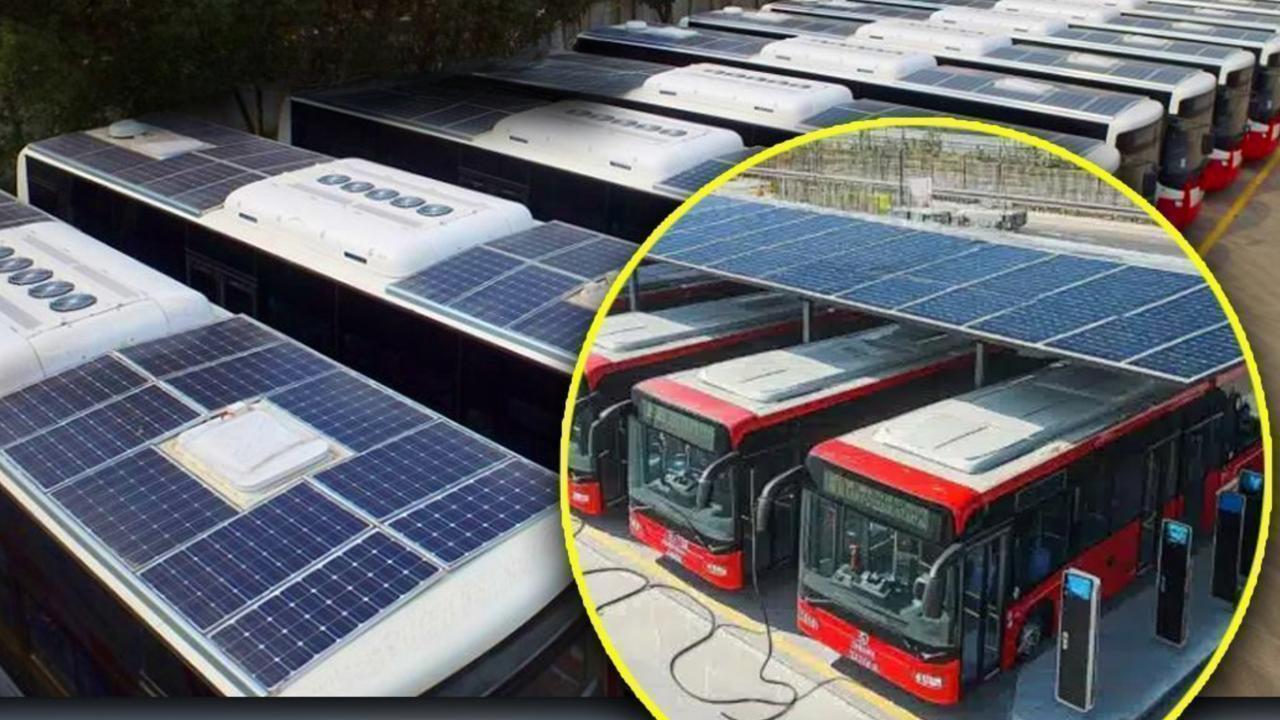
In a picturesque corner of Central Europe, something subtle yet significant is unfolding on the winding rural roads of the Czech Republic. It doesn’t roar with the urgency of electrification or dazzle like autonomous driving. Instead, it hums quietly atop the roofs of rural buses—solar panels, harnessing the sun to power a new kind of HVAC system.
Earlier this month, the Czech Ministry of Transport, in collaboration with the energy research group ČEZ Energo and the regional bus operator ČSAD Autobusy Plzeň, rolled out a groundbreaking pilot program that integrates solar-assisted HVAC systems into public buses servicing rural and semi-rural routes in the Plzeň and South Moravian regions. The project aims to cut HVAC-related fuel consumption, improve thermal comfort for passengers, and evaluate the long-term feasibility of solar energy in transport air management systems.
Tackling Hidden Energy Drains in Rural Transport
While electrification grabs headlines across Europe’s public transit circles, the energy footprint of HVAC systems in internal combustion engine (ICE) and hybrid buses remains largely overlooked. In rural fleets—where fully electric models are often impractical due to long routes, poor charging infrastructure, and harsh seasonal swings—the heating and cooling load can account for up to 25% of total fuel use during peak seasons, according to a recent white paper by the Czech Technical University in Prague.
Recognizing this hidden inefficiency, the Czech Ministry of Transport issued a technology innovation grant in early 2024, seeking practical, low-disruption solutions that could be deployed across older fleets without requiring full drivetrain replacement. That’s when ČEZ Energo and ČSAD proposed a modular, solar-assisted HVAC concept that didn’t just align with national climate targets—it was simple, retrofittable, and scalable.
The System: Compact, Modular, and Weather-Smart
Each bus in the pilot fleet has been fitted with four lightweight solar panels totaling 720 watts, installed along the roofline. These panels power a dedicated HVAC unit with integrated battery storage and smart thermal regulation software. During sunny periods, solar energy feeds directly into the HVAC’s compressor and fan modules. When sunlight dips or load spikes, the system draws from a compact 2.5 kWh battery pack—tucked unobtrusively beneath the passenger seating.
Designed by local engineering firm Thermovolt Systems, the HVAC unit comes equipped with multi-zone sensors that adapt airflow and temperature based on real-time passenger density and external weather conditions. It’s even connected to a cloud-based fleet management interface that lets operators monitor energy consumption, temperature settings, and battery health across the fleet.
Initial Results Show Fuel Savings and Passenger Comfort Gains
In the first 30 days of the trial, fuel consumption related to air conditioning and heating saw a reduction of 17–22% on average across the test routes. That figure may rise further during the peak summer stretch in July and August. According to preliminary data, the HVAC systems ran on solar power alone for nearly 46% of daytime operational hours, especially on routes with prolonged idling at rural bus stops or low-speed travel through agricultural zones.
Passenger satisfaction surveys conducted by ČSAD showed a marked improvement in perceived air quality and temperature consistency, especially during midday summer runs when older diesel buses typically struggle with fluctuating internal climates. Drivers, too, reported lower cabin fatigue thanks to more stable climate control during long rural loops.
Why Rural Routes Are Ideal for This Innovation
According to Ladislav Toman, director of the Ministry’s Green Mobility Program, rural and semi-rural routes are uniquely suited for solar-assisted HVAC systems. These buses spend more time parked between shifts, cover longer distances between cities, and frequently idle under direct sunlight—conditions where solar capture becomes particularly efficient.
Urban buses, by contrast, have heavier stop-start patterns and operate in shadow-heavy environments with denser buildings. For them, battery-electric HVAC or grid-fed charging may still be more appropriate.
“But in the Czech countryside,” Toman explains, “we have long stretches of sunlit road and no easy access to depots with fast-charging or grid-tied HVAC. Solar HVAC is a way of turning that challenge into an advantage.”
A Pragmatic Bridge Between ICE and Full Electrification
What makes this Czech trial particularly compelling is that it doesn’t rely on an all-or-nothing transition. Many rural fleet operators across Europe are hesitant—or financially unable—to immediately retire ICE buses in favor of electric models. Costs, charging logistics, and road conditions remain prohibitive in certain regions. For them, solar HVAC offers a pragmatic middle path: a way to modernize energy usage without replacing the entire bus.
“Even if we electrify just one function—like air management—we can see real-world energy savings and better comfort,” says Hana Bartošová, chief engineer at ČEZ Energo. “It’s about squeezing value from every ray of sunlight and every kilometer traveled.”
She adds that the entire HVAC retrofit—including installation, panel mounting, and battery integration—costs under €5,000 per bus, a figure the company expects to lower by 20% once scaled.
Scaling Potential and the European View
Following the promising pilot data, the Czech Ministry is preparing to extend the program to 150 additional buses across five more regions by early 2026. Talks are already underway with Slovakia, Hungary, and Poland, where rural bus fleets face similar limitations.
In Brussels, EU transportation observers are watching the trial with growing interest. The European Climate, Infrastructure and Environment Executive Agency (CINEA) recently flagged solar HVAC retrofits as a “tier-two priority” in its 2026 Clean Transport Innovation Outlook. If successful, such retrofits may qualify for co-funding under Horizon Europe’s rural mobility initiatives.
Even without direct EU subsidies, the market appeal is strong. Over 30% of the Czech Republic’s intercity and rural buses still run on diesel, and full electrification for them remains at least a decade away. Adding a solar-powered HVAC layer offers a way to incrementally modernize operations while supporting national emissions targets.
Voices from the Road: A Human Impact
For bus driver Vít Kořínek, who’s driven routes between Blatná and Klatovy for 18 years, the difference is noticeable. “Before, you’d crank the A/C and pray the passengers in the back didn’t start opening windows. Now, it just runs quietly. You don’t even think about it—but the cabin feels balanced, not stuffy or freezing.”
And for passengers like 76-year-old Jana Hrubá, who travels weekly to visit her daughter in the next town, the new system is more than a technical feature. “The air used to be heavy—too hot in summer, too cold in winter. I once fainted. But now, even on warm days, it feels calm. Like it should.”
What’s Next: AI Integration and All-Season Testing
The team at Thermovolt is already working on the next-generation version of the HVAC system, which will integrate AI-based route prediction to optimize energy use based on elevation changes, traffic forecasts, and solar intensity projections. They’re also developing a winterized version with low-temperature performance enhancements, slated for trial during the upcoming 2025–26 winter season in the hilly Bohemian Highlands.
According to CTO Jan Novotný, “Solar isn’t just a summer solution. Even in winter, ambient light and smart algorithms can stretch performance. Our goal is to reach 65% HVAC solar utilization—even in mixed climates.”
A Small Upgrade with Big Implications
In an era dominated by large-scale electrification debates and the pressure to decarbonize quickly, the Czech Republic’s solar HVAC trial reminds us of the value of micro-innovations—those small, smart improvements that can ripple across sectors. By targeting HVAC systems, often ignored yet deeply energy-intensive, Czech engineers and transit planners have found a sweet spot where passenger comfort, climate goals, and rural practicality converge.
If successful at scale, this initiative could reshape how Europe approaches the modernization of aging bus fleets—not by waiting for battery-electric perfection, but by embracing intelligent, transitional steps powered by the most democratic energy source of all: the sun.
As the buses continue to glide through the countryside, quietly cooled by solar intelligence, the Czech Republic may be paving the road for a future where clean air—and clean air conditioning—go hand in hand.
Czech Republic, Solar Assisted HVAC Pilot



Advances in Aerospace Technology and Commercial Aviation Recovery
Insights into breakthrough aerospace technologies and commercial aviation’s recovery amid 2025 chall

Defense Modernization and Strategic Spending Trends
Explore key trends in global defense modernization and strategic military spending shaping 2025 secu

Tens of Thousands Protest in Serbia on Anniversary of Deadly Roof Collapse
Tens of thousands in Novi Sad mark a year since a deadly station roof collapse that killed 16, prote

Canada PM Carney Apologizes to Trump Over Controversial Reagan Anti-Tariff Ad
Canadian PM Mark Carney apologized to President Trump over an Ontario anti-tariff ad quoting Reagan,

The ad that stirred a hornets nest, and made Canadian PM Carney say sorry to Trump
Canadian PM Mark Carney apologizes to US President Trump after a tariff-related ad causes diplomatic

Bengaluru-Mumbai Superfast Train Approved After 30-Year Wait
Railways approves new superfast train connecting Bengaluru and Mumbai, ending a 30-year demand, easi




