Post by : Saif
Cambodia’s Prime Minister Hun Manet has said that Thai troops are still inside Cambodian territory even after a ceasefire agreement that was brokered by U.S. President Donald Trump. His remarks show that tensions along the Cambodia–Thailand border are far from settled and that peace on the ground remains weak and uncertain.
Speaking during a visit to Washington, Hun Manet said the ceasefire reached in December helped stop open fighting, but did not fully solve the problem. He claimed that troops from Thailand are still positioned in areas that Cambodia considers its own land. According to him, barriers and defensive materials have been placed in these zones, and some local residents are still unable to safely return to their homes.
Thailand has rejected the accusation. Thai defense officials say their military is only holding existing positions as part of the de-escalation plan and has not moved deeper into disputed land. They argue that they are following the joint agreement and have not increased troop numbers in the area.
The border between Cambodia and Thailand stretches for hundreds of miles and has long included disputed sections. In past years, disagreements over maps, landmarks, and historical claims have caused repeated tension. Last year’s clashes were reported to be the worst in more than a decade. The violence forced many families to flee and also disrupted trade and daily life near the border.
Hun Manet has urged Thailand to restart formal boundary work through a joint border commission. This group is meant to use old treaties, maps, and technical surveys to mark the exact border line. He said this technical process is the only fair way to check facts on the ground and prevent new conflict. Cambodia wants the commission to begin work as soon as possible, especially in sensitive “hot zone” areas.
Thai officials responded that such a commission can move forward after government processes linked to their recent election are completed. Cambodia says the election period had earlier been given as the reason for delay and now expects progress.
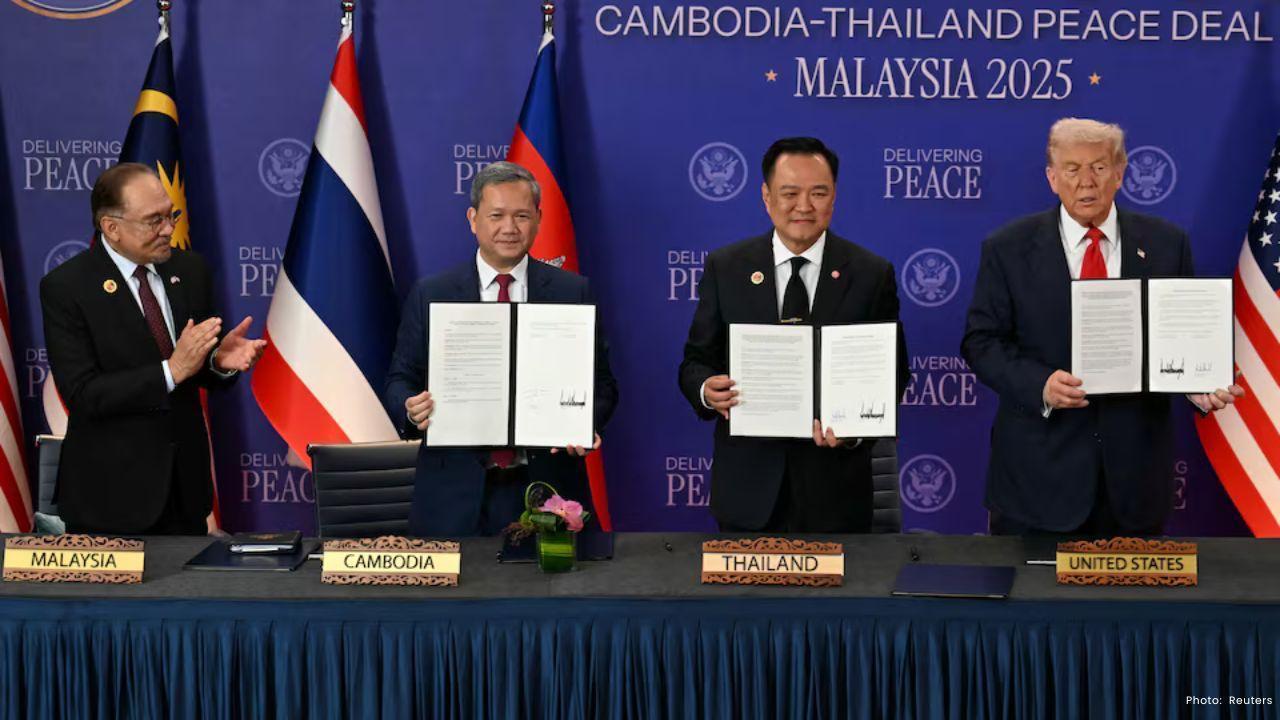
The ceasefire deal itself was signed with support from the United States and regional partners, including Malaysia, during talks connected to an Association of Southeast Asian Nations summit. The agreement followed an earlier peace attempt that broke down within weeks. That history makes observers cautious about how strong the current truce really is.
Hun Manet described the present situation as fragile. He said that without proper demarcation and mutual agreement, the risk of new clashes will remain. Even small misunderstandings between patrols on the ground can grow into larger incidents if borders are not clearly marked and accepted by both sides.
During the same visit, the Cambodian leader also spoke about wider relations with Washington. Ties between the two countries had been strained in earlier years over democracy and human rights concerns. Hun Manet said cooperation is improving, especially in security and law enforcement areas. He also addressed concerns about cyber scam centers operating in Cambodia, saying his government is working to shut them down and deport people involved.
On foreign policy, he said Cambodia does not want to choose between the United States and China. He stressed that his country wants friendly relations with both and sees these partnerships as separate, not conflicting. He added that Cambodia is a sovereign nation and makes its own decisions about security and development.
The border dispute now stands as a key test of regional diplomacy. A ceasefire on paper is important, but real peace depends on trust, verified borders, and steady communication. If joint technical teams can begin their work and both sides accept the results, tensions may ease. If not, the area could again face uncertainty.
For the people living near the frontier, the main hope is simple: clear borders, safe villages, and a return to normal daily life without fear of renewed fighting.
#trending #latest #Cambodia #Thailand #BorderDispute #Ceasefire #DonaldTrump #HunManet #ASEAN #Geopolitics #SoutheastAsia #armustnews



Advances in Aerospace Technology and Commercial Aviation Recovery
Insights into breakthrough aerospace technologies and commercial aviation’s recovery amid 2025 chall

Defense Modernization and Strategic Spending Trends
Explore key trends in global defense modernization and strategic military spending shaping 2025 secu

Tens of Thousands Protest in Serbia on Anniversary of Deadly Roof Collapse
Tens of thousands in Novi Sad mark a year since a deadly station roof collapse that killed 16, prote

Canada PM Carney Apologizes to Trump Over Controversial Reagan Anti-Tariff Ad
Canadian PM Mark Carney apologized to President Trump over an Ontario anti-tariff ad quoting Reagan,

The ad that stirred a hornets nest, and made Canadian PM Carney say sorry to Trump
Canadian PM Mark Carney apologizes to US President Trump after a tariff-related ad causes diplomatic

Bengaluru-Mumbai Superfast Train Approved After 30-Year Wait
Railways approves new superfast train connecting Bengaluru and Mumbai, ending a 30-year demand, easi




