Post by : Saif
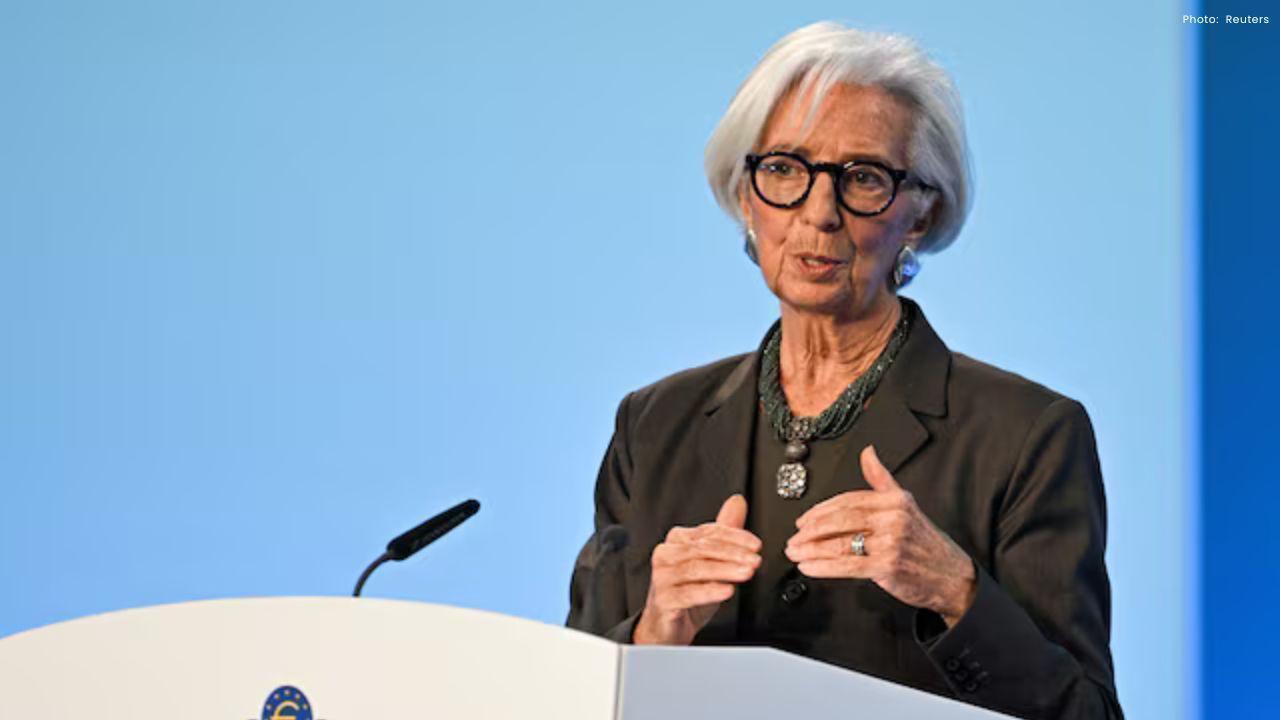
A new report has stirred discussion across Europe’s financial and political circles after it said Christine Lagarde could leave her post as president of the European Central Bank before her term officially ends. Her current term is supposed to run until October 2027, but the report claims she may step down earlier, before the next French presidential election.
The report, published by the Financial Times, said the possible early exit could allow French President Emmanuel Macron and German Chancellor Friedrich Merz to play a strong role in choosing her successor. Under current rules, Macron cannot run for another term, so the timing of major European appointments has become more politically sensitive.
The ECB quickly responded by saying no final decision has been made. A spokesperson said Lagarde remains fully focused on her work and duties and has not chosen an early departure date. Still, the wording of the response was softer than past statements, when the bank had clearly said she planned to complete her full term. That small change in tone has caught the attention of market watchers.
From an editorial point of view, the issue is not only about one leader leaving early. It is about how leadership changes at powerful financial institutions can affect trust, stability, and independence. The ECB is one of the most important central banks in the world. It sets interest rates for the eurozone and guides monetary policy for millions of people and businesses. Even rumors about leadership change can raise questions.
So far, financial markets have stayed calm. Bond yields and the euro currency showed only small moves after the report came out. This suggests investors believe that even if Lagarde leaves early, the ECB’s policy path may not change much. Many ECB decisions are made by group agreement rather than by one person alone. Because of this system, a new president would still work within an established policy framework.
The timing mentioned in the report is also important for political reasons. There is concern among some European officials that rising support for far-right parties in parts of Europe could make future leadership choices more difficult. By stepping down earlier, the argument goes, today’s mainstream leaders would have more influence over who takes charge next at the ECB.
Several possible successors are already being discussed in financial circles. These include Klaas Knot, Pablo Hernandez de Cos, and Joachim Nagel. Another well-known figure, Isabel Schnabel, has also shown interest, but legal limits on ECB board terms may stand in her way. In the past, however, surprise candidates have appeared late in the process, including Lagarde herself when she was first chosen.
It is also worth noting that Lagarde came to the ECB after leading the International Monetary Fund and serving as France’s finance minister. She brought political experience and global visibility to the role. During her time at the ECB, she guided the bank through periods of high inflation, rate increases, and economic recovery after major global shocks.
Right now, the eurozone economy is in a relatively steady phase compared to recent years. Inflation is closer to target, and interest rates are seen as near neutral levels. Growth is modest but stable. This makes the present moment calmer than many past periods. Some experts say that if a leadership change must happen, a stable period is the least risky time.
Still, central bank independence is a key principle in modern economies. The ECB is designed to operate without political pressure. Any suggestion that timing of leadership change is linked to election politics will naturally invite debate. Even if the intention is stability, perception also matters.
In the end, until an official announcement is made, the report remains only a report. But it has already started an important conversation about how Europe chooses its top financial leaders, how politics and policy can mix, and why clear communication from institutions like the ECB is essential for public trust.
#trending #latest #ChristineLagarde #ECB #Eurozone #CentralBank #EuropeanEconomy #MonetaryPolicy #EmmanuelMacron #FinancialLeadership #GlobalFinance #armustnews



Advances in Aerospace Technology and Commercial Aviation Recovery
Insights into breakthrough aerospace technologies and commercial aviation’s recovery amid 2025 chall

Defense Modernization and Strategic Spending Trends
Explore key trends in global defense modernization and strategic military spending shaping 2025 secu

Tens of Thousands Protest in Serbia on Anniversary of Deadly Roof Collapse
Tens of thousands in Novi Sad mark a year since a deadly station roof collapse that killed 16, prote

Canada PM Carney Apologizes to Trump Over Controversial Reagan Anti-Tariff Ad
Canadian PM Mark Carney apologized to President Trump over an Ontario anti-tariff ad quoting Reagan,

The ad that stirred a hornets nest, and made Canadian PM Carney say sorry to Trump
Canadian PM Mark Carney apologizes to US President Trump after a tariff-related ad causes diplomatic

Bengaluru-Mumbai Superfast Train Approved After 30-Year Wait
Railways approves new superfast train connecting Bengaluru and Mumbai, ending a 30-year demand, easi




