Post by : Saif
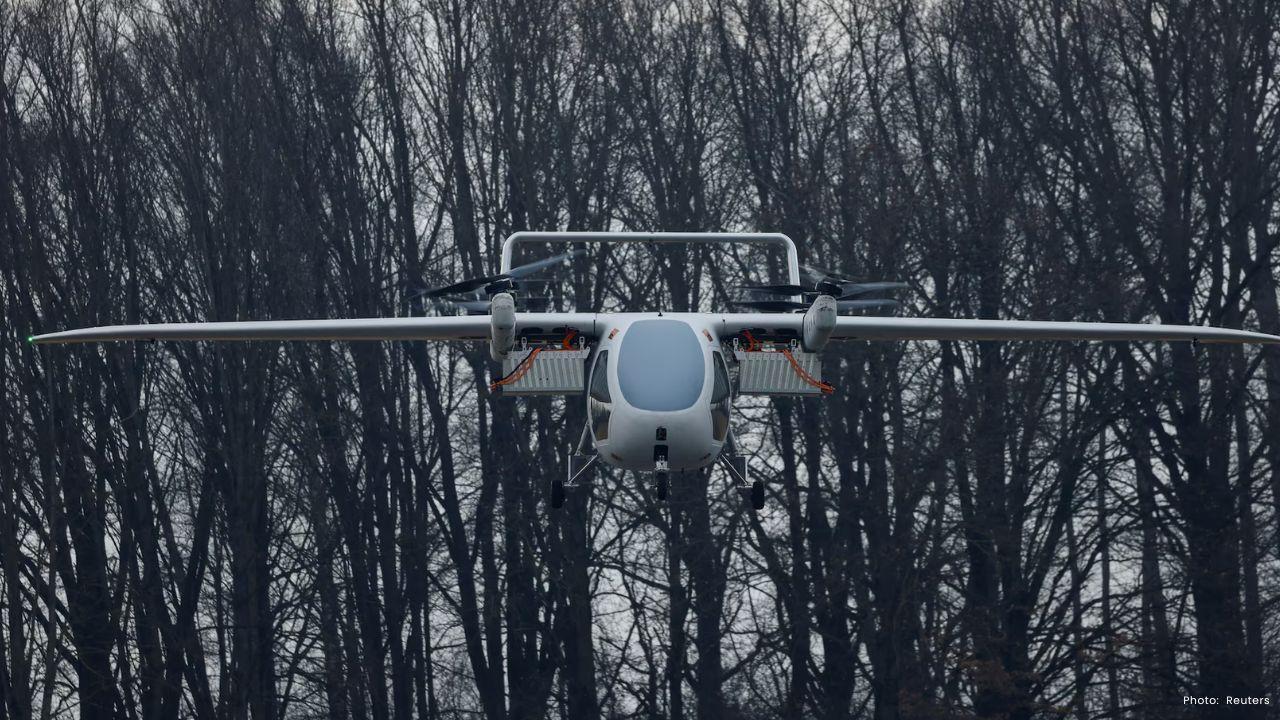
A new chapter in electric aviation has begun in Germany. A Munich-based startup has successfully carried out the first public test flight of a large electric vertical takeoff and landing aircraft, also known as an eVTOL. The aircraft, named Romeo, is designed to carry heavy loads and support emergency missions such as moving patients between hospitals quickly.
The test flight took place at the Erding military airfield near Munich. The event drew attention because Romeo is not a small drone or air taxi model. It is a large, helicopter-sized aircraft built for serious work. According to the company, it is among the biggest electric vertical takeoff aircraft developed in Europe so far.
The project was developed by ERC System, a startup company focused on electric aviation technology. The team says the goal is to build an aircraft that is both powerful and cleaner than traditional helicopters.
Romeo is a heavy prototype weighing about 2.7 tonnes. It has a wingspan of around 16 meters, which is similar to the size of a helicopter. Unlike normal planes that need a runway, this aircraft can take off and land vertically. That means it can operate from small areas, which is useful in emergency situations.
During the public test, the aircraft flew without passengers for safety reasons. Even though it has space for six seats, the first demonstration focused only on proving that the aircraft could safely lift its full structure into the air and operate in stable conditions.
Company leaders said the main purpose of this early flight was simple: show that the technology works at a heavy scale. Lifting a multi-ton electric aircraft is not easy. Batteries, motors, and flight systems must work together perfectly.
One of the most important planned uses for Romeo is medical transport. Instead of replacing helicopters completely, the aircraft could support rescue teams by carrying equipment or moving patients between hospitals faster and at lower cost.
A German rescue flight operator, DRF Luftrettung, is already supporting the project and plans to become a future customer. The rescue group believes that electric aircraft like Romeo could reduce fuel costs, lower noise, and shorten travel times for hospital transfers.
Fast hospital-to-hospital transport can save lives, especially in cases where patients need special treatment that is only available in certain medical centers. If electric aircraft can do this work more cheaply and quietly, emergency services could expand their reach.
Another important feature of Romeo is flexibility. The aircraft can be flown by a pilot or operated without a pilot using remote or automated systems. This dual-mode design gives operators more choices depending on the mission. For example, a piloted flight may be preferred for patient transport. But for cargo or equipment delivery, an unmanned flight could be safer and more efficient. This also opens doors for use in disaster zones where conditions may be dangerous for crew members.
ERC System says it hopes to bring Romeo to the market by 2031. That means several more years of testing, safety checks, and certification work lie ahead. Aviation authorities require strict proof that new aircraft are safe before they can be used commercially.
The company’s target is for the final version to carry a payload of about 500 kilograms. Payload means the weight of passengers, patients, or cargo that the aircraft can transport, not counting the aircraft itself.
Even though the current prototype is large, future versions may be improved to carry more efficiently and travel longer distances as battery technology improves.
The global eVTOL industry has faced financial ups and downs in recent years. Some companies have struggled with high development costs and slow approval processes. However, ERC System says it is in a stable financial position.
The startup is a subsidiary of German technology company IABG, which also provides services to the German armed forces. According to company officials, IABG has invested a significant multi-million-euro amount into the project. This backing gives ERC more stability than many smaller startups in the same field.
Still, questions remain about final costs, pricing, and how quickly customers will adopt electric aircraft for heavy missions. The company has not yet shared expected market prices for Romeo once it becomes available.
The successful public test flight of Romeo shows that electric aviation is moving beyond small demonstration drones and toward larger, more useful aircraft. While commercial passenger air taxis often get the most headlines, heavy-lift and medical support aircraft may become the first area where electric vertical flight proves its value.
Electric systems offer possible benefits such as lower emissions, reduced noise, and simpler maintenance compared to fuel-powered helicopters. But challenges remain, especially in battery range, charging speed, and certification rules.
Even so, this first public flight marks an important step. It shows that large electric vertical takeoff aircraft are no longer just ideas on paper. They are now flying and being tested for real-world missions that could improve emergency care and transport.
#trending #latest #ElectricAircraft #eVTOL #Munich #AviationNews #AirMobility #EmergencyTransport #GreenAviation #FutureFlight #TechnologyNews #armustnews



Advances in Aerospace Technology and Commercial Aviation Recovery
Insights into breakthrough aerospace technologies and commercial aviation’s recovery amid 2025 chall

Defense Modernization and Strategic Spending Trends
Explore key trends in global defense modernization and strategic military spending shaping 2025 secu

Tens of Thousands Protest in Serbia on Anniversary of Deadly Roof Collapse
Tens of thousands in Novi Sad mark a year since a deadly station roof collapse that killed 16, prote

Canada PM Carney Apologizes to Trump Over Controversial Reagan Anti-Tariff Ad
Canadian PM Mark Carney apologized to President Trump over an Ontario anti-tariff ad quoting Reagan,

The ad that stirred a hornets nest, and made Canadian PM Carney say sorry to Trump
Canadian PM Mark Carney apologizes to US President Trump after a tariff-related ad causes diplomatic

Bengaluru-Mumbai Superfast Train Approved After 30-Year Wait
Railways approves new superfast train connecting Bengaluru and Mumbai, ending a 30-year demand, easi




